

A truly “safe” state test score is one that shows your child is at “Meets Grade Level” or higher — not just “Approaches.” Approaches is technically passing in most states, but it signals your child has gaps that could grow next year without support. Meets Grade Level means your child is genuinely on track. Here is how to read the full report and know what each number actually means.
Every summer, millions of parents open a state test score report and feel confused.
The numbers look fine. But is the score actually okay?
This guide breaks down exactly what the score levels mean, why “passing” does not always mean “on track,” and what to look for beyond the headline number.
State Test Score vs Report Card Grade — Two Different Things
The first thing to understand is that a state test and a report card measure different things.
A state test tells you how your child did against a statewide standard — not just their teacher’s expectations. A child can earn strong grades and still have gaps the state expects by that grade, or the reverse.
Your child’s teacher sets grades based on classroom work, participation, and effort.
The state test measures whether your child has learned the specific skills the state says all students at that grade level must know.
Both matter. But they answer different questions.
What Each Level Actually Means
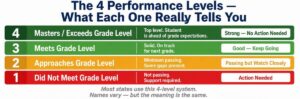
Most states use a four-level performance system. The names vary by state, but the meaning is consistent.
Level 4 or 5 — Masters / Exceeds Grade Level
This is the top level.
Your child has demonstrated a thorough understanding of grade-level content.
Students at this level demonstrate critical thinking and application across various contexts — they are expected to succeed in the next grade with minimal intervention.
No immediate action is required. This is genuinely strong performance.
Also Read: College Board Launches 2 Brand New AP Courses: Is Your School Eligible?
Level 3 — Meets Grade Level
This is the solid passing level and the target most educators consider “safe.”
A student at this level shows strong knowledge of course content and is prepared to progress to the next grade.
Your child understands the material and is on track. Some targeted support might still help in specific areas, but there is no cause for concern.
Level 2 — Approaches Grade Level
This is technically a passing score in most states.
But parents should not treat it like “Meets.”
Approaches with year-over-year growth is a different story from Approaches with a drop in performance from the prior year. The level shows likelihood of success, not a fixed verdict — outcomes change based on the support and interventions a student receives.
A student at this level shows some knowledge of course content but may be missing critical elements — they may need additional support in the coming year.
Think of Approaches as a yellow light — not a red one, but not something to ignore.
Level 1 — Did Not Meet Grade Level
This is the not-passing result.
Students at this level are unlikely to succeed without significant, ongoing intervention due to insufficient understanding of the assessed knowledge and skills.
In most states, a “Did Not Meet” result legally requires the school to provide accelerated instruction.
If your child received this level, contact their teacher and ask specifically what support will be in place next year.
So What Is a “Safe” Score?
The honest answer is that “safe” depends on what you mean by it.
If you mean technically passing — Approaches Grade Level qualifies in most states.
If you mean your child is genuinely on track — Meets Grade Level is the real safe zone.
A child who consistently scores at Approaches for two or three years in a row is falling behind slowly. It may not look like a problem until middle school, when the gaps become harder to close.
Meets Grade Level means your child is keeping pace with what the state expects. That is the benchmark worth aiming for.
How to Read the Full Score Report
The overall performance level is just the first number on the report. Here is what else to look at.
The Reporting Category Breakdown
Below the overall score, the report breaks performance down by content strand — the specific skills within a subject. A child can land at Approaches overall while showing strength in three categories and weakness in one. That is a different situation from a child whose scores are mediocre across the board, and it points to a different kind of support.
This section is the most useful part of the report for planning.
If your child scored at Approaches in Math but did well in geometry and poorly in fractions, the focus for next year is specific — not a general “needs math help.”
Also Read: US History Regents June 2026 — Conversion Chart & Scoring Key
The Year-Over-Year Progress Score
Most state reports include a growth or progress measure that compares this year’s score to last year’s.
Watching the same student’s performance shift in the same subject across years is more useful than ranking them against other students in a single year.
A child moving from Level 1 to Level 2 is making real progress — even if they have not yet reached passing.
A child dropping from Level 3 to Level 2 is worth paying closer attention to, even if the score still shows “passing.”
The Percentile Rank
Percentile rank compares the student to other students in the same grade nationally. A percentile rank of 39 means the student scored higher than 39 percent of students in the same grade nationally.
Percentile rank is context — not a judgment.
It tells you where your child stands relative to peers, not whether they are meeting the state’s requirements for their grade.
Always read percentile rank alongside the performance level, not instead of it.
Why Your Child May Have Scored Lower Than You Expected
One of the most common surprises for parents is a gap between school grades and state test scores.
A child can earn A’s and B’s in class and still score at Approaches on the state test.
This does not mean the teacher graded too easily or the test was unfair.
It usually means classroom grades measure a broader range of things — effort, participation, improvement, homework — while the state test measures only mastered skills against a fixed standard.
When you see a gap, it is worth asking the teacher: which specific skills on the state standard is my child missing?
That conversation is more productive than focusing on the score number alone.
State Test Score Reports by State — Where to Find Them
Each state has its own portal for accessing results.
| State | Test Name | Where to Access Results |
|---|---|---|
| Texas | STAAR | TexasAssessment.gov (Family Portal) |
| California | CAASPP | caaspp.org / School district parent portal |
| New York | Grades 3–8 ELA & Math | nysed.gov Family Portal |
| Florida | FAST | flfast.org / District parent portal |
| All states | Varies | Your school district’s parent portal |
You will typically need your child’s student ID or a unique access code provided by the school. If you cannot find it, call the school’s front office and ask for your child’s assessment access code.
What to Do After You Read the Report
Your next step depends on what level your child scored.
If your child scored at Meets or Masters, note it, celebrate it, and keep doing what is working. You can look at the reporting category breakdown to find any specific areas to reinforce before next year.
If your child scored at Approaches, use the category breakdown to identify the specific skill gaps. Talk to the teacher in September with that information ready. Ask what the plan is for closing those gaps during the school year.
If your child received a Did Not Meet, contact the school before the year ends. Districts are required by state law to provide accelerated instruction for students who do not meet grade level. Ask what that will look like and when it starts.
In every case — the score is an informative and important data point, but it should not define your child’s potential. It shows where they are right now, not where they will be.
Frequently Asked Questions
Is “Approaches Grade Level” a passing score?
Yes, in most states Approaches is a passing score. However, it is the minimum passing level and signals that your child may have gaps that need support. Approaches indicates the student is likely to succeed next year with targeted academic intervention. It is not a cause for panic, but it is worth addressing.
What is a “safe” state test score?
Meets Grade Level is the genuinely safe zone. It shows your child understands grade-level content and is on track for the next year. Approaches is passing but should be monitored — especially if it appears for the same subject two years in a row.
My child gets good grades but scored low on the state test. Why?
A child can earn strong grades and still have gaps the state expects by that grade. The state test measures performance against a fixed standard, while report card grades reflect a broader range of factors including effort, participation, and improvement. Both measures are useful and measure different things.
What does the reporting category breakdown show?
The reporting category breakdown shows performance within specific content strands inside a subject. A child can score at Approaches overall while showing strength in some categories and weakness in others. That breakdown tells you exactly where the gaps are — which is far more useful than the overall score alone.
Does a low state test score mean my child will be held back?
Texas law prohibits automatic retention based solely on STAAR test results. Most other states have similar protections. Grade retention decisions involve multiple factors and require school, parent, and in some cases district approval. A single state test score is not typically the sole determining factor.
How is a scaled score different from a raw score?
A raw score is simply the number of questions answered correctly. A scaled score adjusts for question difficulty — questions that are harder are worth more when answered correctly. The scaled score is what determines your child’s performance level, not the raw score.
What should I ask the teacher after seeing state test results?
Three questions worth asking: Which specific skills does my child need to strengthen? What does the reporting category breakdown show about where the gaps are? What will the school do differently to address those gaps next year? Bringing the score report itself to the conversation makes that discussion more focused and productive.
Bottom Line
Approaches Grade Level is passing. But Meets Grade Level is the score that truly signals your child is on track.
The overall level is just the start. The reporting category breakdown, the year-over-year growth trend, and the specific skill gaps within each subject give you the information you actually need to support your child.
If the score is lower than expected, one conversation with the teacher — focused on specific skills, not the number — is always more useful than worrying about the level alone.
Official Score Report Portals:
- Texas STAAR: TexasAssessment.gov
- California CAASPP: caaspp.org
- New York Grades 3–8: nysed.gov — Grades 3-8
- Florida FAST: flfast.org
Last Updated: June 25, 2026.