

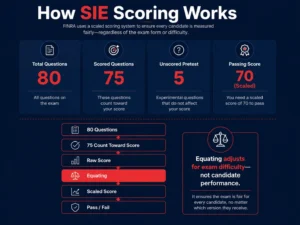
The FINRA SIE exam now has 80 questions, not 85. Only 75 count toward your score, and you need a scaled score of 70 to pass. Here is exactly how that number breaks down, section by section, plus a pacing plan for test day.
The Question Count Just Changed. Here Is What’s Actually on the Exam Now
If you have seen the SIE described as an “85-question exam,” that information is outdated.
Effective October 27, 2025, FINRA cut the number of unscored pretest items from 10 to 5. That changed the total from 85 questions to 80.
The scored portion did not change. You still answer 75 scored multiple-choice questions, and you still need a 70 to pass.
The 5 unscored items are experimental. FINRA uses them to test future exam questions before those questions count toward anyone’s score.
You cannot tell which 5 are unscored. They are mixed randomly throughout the exam, so every question has to be treated as if it counts.
Your exam time did not shrink to match. You still get 1 hour and 45 minutes, which now covers 5 fewer total questions.
How Many of the 75 Scored Questions Can You Miss?
FINRA does not publish a fixed answer key for “how many you can miss.” That number is not officially fixed, and here is why.
The passing score is 70 on a 0–100 scale. FINRA does not simply calculate that as 70% of 75 correct answers.
Instead, FINRA uses a process called equating. Your raw score gets statistically adjusted based on the difficulty of the specific set of questions you received.
Equating exists so that a candidate who receives a slightly harder question set is not unfairly disadvantaged compared to someone with an easier set.
Because of equating, the exact number of correct answers needed can shift by a question or two between different test forms.
With that caveat clearly stated, the widely used estimate among test-prep providers is this: roughly 53 correct answers out of 75 clears the 70 scaled threshold.
That would mean you have some room, roughly 22 scored questions, where a wrong answer likely will not sink you.
Treat 53 out of 75 as a planning target, not a guarantee. Aim higher in practice tests to build a safety margin against equating variance.
Is the SIE “Curved”? Clearing Up a Common Misunderstanding
Many candidates use the word “curve” when talking about SIE scoring. That word is misleading, and it is worth correcting.
A true curve adjusts your passing bar based on how other candidates performed that day. The SIE does not work that way.
The passing score of 70 is fixed. It does not move up or down depending on whether other test-takers had a good or bad day.
Equating only adjusts for question-set difficulty, not for the performance of your specific testing cohort. This is a criterion-referenced exam, not a curved one.
That distinction matters for your prep. Studying to a fixed standard is more predictable than trying to guess how a “curve” might behave.
Do the 4 Sections Have Separate Passing Requirements?
No. The SIE gives you one overall score. There is no minimum score required within any individual section.
That said, section weight still matters strategically, because each section holds a different number of scored points.
| Section | Weight | Scored Questions |
|---|---|---|
| Knowledge of Capital Markets | 16% | 12 |
| Understanding Products and Their Risks | 44% | 33 |
| Understanding Trading, Customer Accounts and Prohibited Activities | 31% | 23 |
| Overview of the Regulatory Framework | 9% | 7 |
| Total | 100% | 75 |
Understanding Products and Their Risks alone holds 33 of your 75 scored points. That is nearly half of everything the exam measures.
A weak Regulatory Framework score is easier to absorb, since only 7 points are available there. A weak Products score is much harder to offset elsewhere.
The practical strategy: protect your accuracy in the two largest sections first. Products and Trading/Accounts together make up 56 of your 75 scored questions.
A Pacing Blueprint to Get Through All 80 Questions Comfortably
You have 105 minutes for 80 questions. That works out to roughly 79 seconds per question on average.
Because 5 unscored questions are hidden among the 75 scored ones, you cannot pace differently for “the parts that count.” Every question gets the same effort.
Use time checkpoints instead of trying to identify which questions matter more. Here is a simple four-quarter structure to follow.
| Checkpoint | Questions Completed | Target Elapsed Time |
|---|---|---|
| Quarter 1 | 20 of 80 | ~26 minutes |
| Quarter 2 | 40 of 80 | ~52 minutes |
| Quarter 3 | 60 of 80 | ~79 minutes |
| Final | 80 of 80 | ~95 minutes |
Finishing around the 95-minute mark, instead of the full 105, leaves roughly 10 minutes to revisit any questions you flagged for review.
If a question stalls you for more than 90 seconds, make your best answer, flag it, and move on. There is no penalty for guessing.
Coming back later with fresh eyes on a flagged item often reveals something you missed the first time through.
Should You Try to Guess Which Questions Are Unscored?
No. This is a common instinct, and it wastes energy that should go toward answering correctly.
FINRA deliberately makes the 5 pretest items indistinguishable from the 75 scored ones. There is no reliable pattern candidates can use to spot them.
Spending mental effort trying to identify “safe” questions to skip or rush only increases your risk of missing a question that does count.
The only sound strategy is full effort on all 80 items, answered within your pacing checkpoints.
What Changed Recently That Older Study Guides Might Get Wrong
Two SIE facts changed within roughly the last year, and outdated guides sometimes still show the old numbers.
- Pretest questions dropped from 10 to 5, effective October 27, 2025, lowering the total question count from 85 to 80.
- The exam enrollment fee rose from $80 to $100, effective January 1, 2026.
The passing score, the 75 scored questions, the four content sections, and the 105-minute time limit were not affected by either change.
Quick Facts
- Total questions: 80 (75 scored, 5 unscored pretest)
- Time limit: 1 hour 45 minutes
- Passing score: 70 on a 0–100 scaled score
- Estimated correct answers needed: approximately 53 of 75, treated as an estimate rather than a fixed FINRA figure
- Exam fee: $100
- Eligibility: Age 18 or older, no firm sponsorship required
- Result validity: 4 years
- Retake wait: 30 days after the first two failed attempts, 180 days after a third
What Happens If You Fall Short
A failed attempt is not part of any public record, and it does not end your path into the securities industry.
You will see your pass or fail result immediately on screen, along with a performance breakdown across the four content sections.
After a first or second failed attempt, FINRA requires a 30-day wait before you can retake the exam.
After a third failed attempt, the wait period extends to 180 days. There is no cap on total attempts allowed.
Important Links
| Resource | Official Link |
|---|---|
| SIE Exam Overview (FINRA) | Check |
| SIE Content Outline (PDF) | Check |
| SIE Exam and Exam Restructuring FAQ | Open |
| SIE Practice Test | Check |
| SIE Exam Information for Students | Check |
| SIE Self-Enrollment (TESS) | Open |