What is Trump doing with student loans? His administration is making the biggest changes to federal student loans in over a decade.
The changes come from the One Big Beautiful Bill Act (OBBBA), signed July 4, 2025. Most new student loan rules for 2026 took effect July 1.
This Trump student loan policy explainer covers every change: SAVE ending, new repayment plans, Grad PLUS and Parent PLUS limits, borrowing caps, and a new earnings rule.
Trump Student Loan Changes 2026: Timeline From March 2026 to July 2028
Here is the sequence, in order.
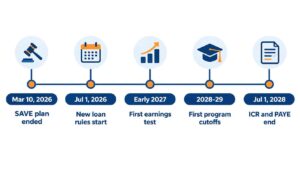
- March 10, 2026: A federal court vacated the SAVE plan after a settlement between the Education Department and Missouri.
- March 27, 2026: The department said SAVE borrowers would get at least 90 days to choose a new plan.
- July 1, 2026: New loan limits, the Repayment Assistance Plan (RAP), and the Tiered Standard Plan took effect. Grad PLUS ended for new borrowers.
- July 1, 2026: Servicers began sending SAVE exit notices, and the final earnings rule was published.
- Early 2027: The first program earnings test is calculated.
- 2028–2029 award year: Earliest point when failing programs can lose Direct Loan eligibility.
- July 1, 2028: ICR and PAYE phase out entirely.
SAVE Is Gone: What Replaced It
The SAVE plan no longer exists. A federal court vacated it on March 10, 2026, ending years of legal fighting.
About 7.5 million borrowers were enrolled. Many spent months in a payment-free SAVE forbearance while the case played out.
Servicers began mailing 90-day exit notices on July 1, 2026. Notices go out in waves through October, so deadlines differ by borrower.
Borrowers who do nothing are placed in the Standard plan or the new Tiered Standard Plan, depending on when their loans were issued.
Most SAVE borrowers can realistically choose Income-Based Repayment (IBR) or RAP, both covered below.
RAP and the Tiered Standard Plan Explained
Repayment Assistance Plan (RAP)
RAP is the new income-driven plan. Payments run from 1% to 10% of your adjusted gross income.
Any remaining balance is forgiven after 30 years of qualifying payments. Unpaid interest is no longer added to your balance when your payment falls short.
Tiered Standard Plan
This is a fixed-payment plan. Your repayment term runs 10 to 25 years, depending on how much you owe.
Borrowers with loans made on or after July 1, 2026 can choose only RAP or the Tiered Standard Plan.
IBR stays available only for loans made before July 1, 2026. ICR and PAYE phase out entirely by July 1, 2028.
Grad PLUS and Parent PLUS Changes
Grad PLUS ended for new borrowers on July 1, 2026. It once let graduate students borrow up to their full cost of attendance.
Students who borrowed for their program before that date can keep borrowing under old limits. The window is three academic years or program completion, whichever comes first.
Parent PLUS was not eliminated. It is now capped at $20,000 per year and $65,000 total for each student.
Those caps cover all parents combined. New Parent PLUS loans must be repaid under the standard plan and are not eligible for RAP.
Parents who borrowed before July 1, 2026 get the same three-year window.
New Federal Student Loan Borrowing Limits by Loan Type
| Loan Type | Annual Limit | Lifetime Limit |
|---|---|---|
| Dependent undergraduate | $5,500 to $7,500 (unchanged) | $31,000 (unchanged) |
| Independent undergraduate | Up to $12,500 (unchanged) | $57,500 (unchanged) |
| Graduate student | $20,500 | $100,000 |
| Professional student | $50,000 | $200,000 |
| Parent PLUS (per student) | $20,000 | $65,000 |
| Grad PLUS | Eliminated for new borrowers | |
| All federal loans combined | N/A | $257,500 (excludes Parent PLUS) |
Interest rates for loans disbursed July 1, 2026 through June 30, 2027 are 6.52% for undergraduates and 8.07% for graduate loans.
PLUS loans carry 9.07%. Rates stay fixed for the life of each loan.
The Low-ROI Fields Restriction
A separate rule limits loans to programs whose graduates earn too little. The Education Department calls it the “do no harm” earnings test.
The department announced the final rule on June 29, 2026 and published it July 1. Criticism peaked in late September.
Undergraduate programs must beat the median earnings of high school graduates in their state. Graduate programs must beat the median for bachelor’s degree holders.
Programs that fail in two of three consecutive years lose Direct Loan eligibility for at least two years.
The first test is calculated in early 2027. The earliest loan cutoffs arrive in the 2028–2029 award year.
Nothing is being cut off today. Early department estimates show about 1% of bachelor’s programs failing, versus about 18% of undergraduate certificates.
Cosmetology certificates are the most exposed, with more than 90% projected to fail.
Critics say the test is too narrow for fields like art, music, and social work. The rule does not ban anyone from studying them.
What Has Not Changed
Undergraduate annual and lifetime loan limits are untouched. Undergraduate loans do now count toward the new overall lifetime cap.
Borrowers with no new loans on or after July 1, 2026 can keep their current plan. That includes Standard, Graduated, Extended, and IBR.
Public Service Loan Forgiveness (PSLF) remains in place. Interest rates on your existing federal loans stay fixed.
The one major exception is SAVE, which ended by court order.
Frequently Asked Questions
Did Trump cancel student loan forgiveness?
No. PSLF is unchanged, and RAP forgives remaining balances after 30 years. SAVE’s faster forgiveness path ended, but that came from a court order.
Will my current repayment plan change?
Not if you take out no new loans on or after July 1, 2026. Borrow again, and all your loans must move to RAP or the Tiered Standard Plan.
What should SAVE borrowers do now?
Find your servicer’s notice and note the date 90 days out. Compare plans in the Loan Simulator, then apply at studentaid.gov before that date.
If you miss it, you are placed in a Standard plan automatically.
Is Grad PLUS completely gone?
For new borrowers, yes. Students who borrowed for their current program before July 1, 2026 can keep using it for up to three academic years.
Last Updated: October 2, 2026. This story is still developing, so check official sources for new guidance.
Helpful Links