

The SAVE plan 90 day deadline extended for some borrowers, but not for everyone. Your new date depends on your servicer and your notice date.
Borrowers with Nelnet and other servicers report deadlines pushed back by two to four weeks. The Education Department has not publicly confirmed or explained these changes.
Here is how to find your exact date and what happens if you miss it.
Quick answer: Log in to your servicer portal and read your notice. Do not rely on a date from social media or a friend’s letter.
If you do nothing, your servicer will place you on the Standard or Tiered Standard plan. Those payments are based on your loan balance, not your income.
Missing the date will not put you in default. But it can raise your monthly payment sharply and change your path to forgiveness.
What the SAVE Plan 90-Day Deadline Is For
The 90-day deadline applies to federal student loan borrowers who are still enrolled in the SAVE plan. It is your window to choose a new repayment plan.
Servicers began sending notices on July 1, 2026. Each notice tells you to leave SAVE and enroll in a lawful repayment plan within 90 days.
The Department of Education has said borrowers get at least 90 days. Your servicer’s notice states your specific date.
Why the SAVE Plan Is Ending
SAVE launched under the Biden administration as an income-driven plan with very low payments. Lawsuits then blocked it for roughly two years.
On March 10, 2026, a federal court order stopped the department from implementing the plan. A settlement finalized earlier this year effectively ended the program.
Many SAVE borrowers sat in forbearance while the case played out. That pause is now ending.
Roughly 6.5 million borrowers remain in SAVE, according to the latest federal data. Notices are going out in waves, so deadlines are staggered.
You do not need to wait for a notice. You can contact your servicer and switch plans at any time.
Why SAVE Deadlines Are Being Extended and Why They Are Inconsistent
The first group of borrowers received notices on July 1. Their original 90-day deadline landed on September 29.
Around that date, borrowers began reporting longer deadlines in their servicer portals. Forbes reported extensions of two to four weeks for some borrowers.
The department has not announced these extensions. As of September 30, its SAVE guidance page did not mention them.
Treat these changes as borrower-reported, not official policy. Your portal and your notice are the only sources that count for your account.
| Reported Case | Original Deadline | Reported New Deadline |
|---|---|---|
| Nelnet borrower | October 13 | November 13 |
| Another borrower (servicer not named) | Not stated | November 25 |
| Nelnet borrower (earlier change) | Not stated | Extended 15 days, then about a month more |
Why Your Date May Differ From Someone Else’s
Your 90 days start on the date of your own notice. Servicers send notices in batches, so each batch has its own clock.
MOHELA says borrowers receive notices between July and October 2026. Nelnet indicates notices may continue through the end of the year.
Servicing problems add to the confusion. Advocacy groups cite website glitches, processing delays, and account errors across the federal loan system.
A separate deadline also moved. The auto-pay enrollment period for the 1 percent interest rate reduction now runs through December 31, 2026.
How to Find Your Specific SAVE Deadline
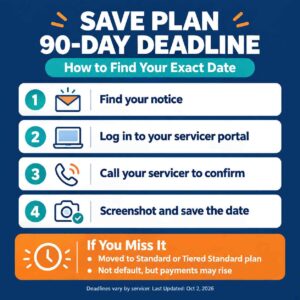
Your exact deadline lives in your notice and your servicer account. Follow these steps in order.
- Find your notice. Check your email, spam folder, and postal mail for a message about leaving SAVE.
- Identify your servicer. Log in at StudentAid.gov and open your loan details to see who services each loan.
- Log in to your servicer portal. Look for a banner, alert, or message center item showing your 90-day date.
- Call your servicer. Ask for your exact deadline and whether it has changed. Expect long hold times.
- Document everything. Screenshot the portal date. Write down the representative’s name, the call date, and any reference number.
What If You Have Not Received a Notice?
You are not late. Notices are still going out, and your 90 days begin when your servicer sends yours.
You can still act now. Contact your servicer and apply for a new plan without waiting.
Can You Calculate the Date Yourself?
Counting 90 days from your notice date gives a rough estimate only. If your portal shows a different date, the portal date controls.
Check again every week or two. Reported extensions have appeared without warning.
What Happens If You Do Nothing
If you miss your deadline, your servicer will automatically move you to a standard repayment plan. Which one depends on when your loans were made.
| Your Loan Situation | Automatic Placement |
|---|---|
| All loans made before July 1, 2026 | Standard Repayment Plan |
| Any loan made or consolidated on or after July 1, 2026 | Tiered Standard Plan |
The older Standard plan generally uses a 10-year term for unconsolidated loans. Consolidation loans have terms that depend on the balance.
The Tiered Standard plan sets a fixed term of 10, 15, 20, or 25 years based on how much you owe.
The Real Costs of Waiting
Both plans base your payment on your balance, not your income. Many borrowers coming from SAVE could see payments double or even triple.
You may also lose progress toward forgiveness. Tiered Standard payments do not count toward Public Service Loan Forgiveness.
Missing the date does not mean default. Borrowers can generally still request a different plan later, but confirm that option with your servicer.
Which Repayment Plan Should You Actually Choose
This is general information, not financial advice. The right plan depends on your income, balance, loan dates, and career goals.
- Income-Based Repayment (IBR): An income-driven plan for eligible loans first made before July 1, 2026.
- Repayment Assistance Plan (RAP): A new income-driven plan that launched July 1, 2026. It is the only income-driven option if you have newer loans.
- Standard or Tiered Standard: Fixed payments based on your balance. These are the automatic landing spots.
Older plans such as PAYE and ICR are scheduled to be phased out by July 2028. Check current availability before applying.
Use the official Loan Simulator at StudentAid.gov. It estimates your payments under each plan using your actual loan data.
Compare monthly payment, total cost, and forgiveness eligibility. Then apply through your servicer or StudentAid.gov.
Frequently Asked Questions
What is the SAVE plan 90-day deadline?
It is the window your servicer gives you to choose a new repayment plan after leaving SAVE. The 90 days start on your notice date.
Has my deadline changed?
Possibly. Borrowers report extensions of two to four weeks, but the department has not publicly confirmed them. Check your servicer portal for your current date.
What happens if I miss it?
Your servicer places you on a standard plan automatically. You will not be in default, but your payment may rise sharply.
You may also lose progress toward forgiveness. Contact your servicer right away if you miss your date.
Which plan will I be placed on automatically?
If all your loans were made before July 1, 2026, you go to the Standard plan. If any loan or consolidation is newer, you go to Tiered Standard.
Do I have to wait for my notice?
No. You can apply for a new plan at any time through your servicer or StudentAid.gov.
Helpful Links
- Education Department SAVE Announcement
- StudentAid.gov Loan Simulator
- Forbes Report on Deadline Extensions
Last Updated: October 2, 2026. This situation is changing quickly, so check your servicer portal for your latest date.