

The National Council of State Boards of Nursing just confirmed it. The overall NCLEX-RN pass rate dropped to 69.1% in 2025, down from 73.3% in 2024. First-time U.S.-educated candidates still passed at 86.7%. But behind these numbers sits a bigger, messier story about nursing schools, accreditation pressure, and exit exams that block graduation.
What Are the Real 2025 NCLEX Pass Rates?
Here’s the number every nursing student should know first.
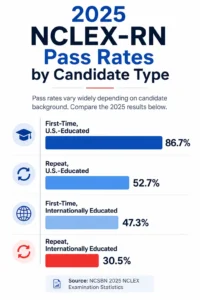
The first-time pass rate for U.S.-educated NCLEX-RN candidates was 86.7% in 2025.
That’s down from 91.2% in 2024 — the lowest first-time rate since 2022, based on year-over-year NCSBN data.
The gap widens once repeat test-takers and internationally educated candidates enter the picture.
Here’s the full 2025 breakdown, straight from NCSBN’s official statistics.
| Candidate Type | Number Tested | Number Passed | Pass Rate |
|---|---|---|---|
| First-time, U.S.-educated | 192,916 | 167,272 | 86.7% |
| Repeat, U.S.-educated | 42,513 | 22,404 | 52.7% |
| First-time, internationally educated | 52,827 | 24,999 | 47.3% |
| Repeat, internationally educated | 40,187 | 12,271 | 30.5% |
| All candidates combined | 328,443 | 226,946 | 69.1% |
Source: NCSBN, 2025 NCLEX Examination Statistics (Research Brief Vol. 96, published June 2026).
A first-time, U.S.-educated candidate is more than 34 percentage points more likely to pass than someone retesting.
Degree type matters too, though the gap is smaller than many students expect.
| Degree Type | First-Time Pass Rate (2025) |
|---|---|
| RN Baccalaureate (BSN) | 87.6% |
| RN Associate Degree (ADN) | 86.1% |
| RN Diploma | 83.3% |
Quick Facts: NCLEX-RN, 2025
- National first-time pass rate: 86.7%
- Repeat test-taker pass rate: 52.7%
- Average test length: 103 items
- Average testing time: 2 hours, 14 minutes
- Passing standard: 0.00 logits (unchanged since 2013)
Why Is There Such a Big Gap Between First-Time and Repeat Test-Takers?
This gap isn’t new. First-time candidates have always outperformed repeat test-takers by a wide margin.
But failing once makes a second pass noticeably harder, especially without focused remediation.
Most states require a waiting period of at least 45 days before you can retest.
Some states also cap how many times you can attempt the exam within a single year.
Educators point to the Next Generation NCLEX format as one reason the gap persists.
Its case studies and clinical judgment items reward deep practice, not memorization.
Why Do Nursing Schools Care So Much About the 80% Threshold?
Here’s what many students don’t realize. Your school’s pass rate isn’t just a statistic.
It can determine whether your program stays open.
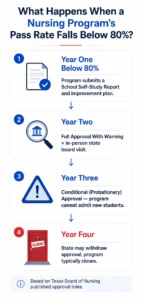
Two major accreditors, CCNE and ACEN, expect nursing programs to keep first-time pass rates at or above 80%.
State boards of nursing add their own rules on top of that, and penalties vary widely.
| State | Rule (as published by the state board) |
|---|---|
| North Carolina | Program pass rate must equal at least 90% of the national pass rate |
| Texas | Programs below 80% must file a School Self-Study Report; repeated shortfalls bring warnings, probation, and possible closure |
| Delaware | Programs below 80% for two consecutive years face provisional approval status |
| Florida | Program funding is tied to staying within roughly 10 percentage points of the national average |
These aren’t minor penalties. A program on probation can lose the ability to admit new students.
In the most serious cases, the state withdraws approval and the program closes.
Are Nursing Schools Using Exit Exams to Protect Their Statistics?
This is where student frustration boils over.
Many nursing programs require a standardized “exit exam,” like HESI or ATI, before graduation.
Critics argue some schools use these exams less as teaching tools and more as a filter.
Struggling students get blocked from graduating and never reach the NCLEX at all.
ACEN’s own accreditation data confirms the scale of this problem.
In one recent reporting year, more than 860 students were delayed or blocked from graduating because of high-stakes standardized testing policies, according to ACEN’s own published review.
Some students have taken schools to court over this exact issue.
Lawsuits and public petitions describe students finishing every course and clinical rotation, only to be denied a degree over one exam score.
ACEN has been clear it never required exit exams in the first place.
The pressure to use them mostly comes from schools’ fear of falling below accreditation thresholds.
Big Change Coming: ACEN Is Banning High-Stakes Exit Exams
Here’s the part most coverage of this topic has missed.
ACEN’s Board of Commissioners approved a new rule in January 2026 that directly targets this practice.
Policy #39, the High-Stakes Testing Policy, takes effect September 1, 2026.
It applies to every ACEN-accredited nursing program in the country.
Under the new policy, a program can no longer use a single exit exam score to block graduation outright.
Exit exams must instead be used diagnostically.
That means identifying weak spots and directing students toward remediation, not ending their nursing career.
Programs that keep using exit exams as strict gatekeepers, even with multiple retakes allowed, risk being found non-compliant with ACEN’s policy.
If your school uses HESI, ATI, or a similar exit exam, ask how it plans to comply before the September 2026 deadline.
What’s Actually Changing in the April 2026 NCLEX Test Plan?
A new NCLEX test plan took effect April 1, 2026.
That phrase alone has caused plenty of unnecessary panic online.
Here’s the reassuring part: NCSBN confirmed the passing standard did not change.
It stays at 0.00 logits for the NCLEX-RN and -0.18 logits for the NCLEX-PN through March 2029.
The Next Generation question formats, including case studies, bowtie items, and matrix questions, remain exactly the same.
The real changes are mostly language updates.
“Safety and Infection Control” is now called “Safety and Infection Prevention and Control.”
“Substance abuse” became “substance misuse,” reflecting more current clinical language.
If you prepared using the 2023 test plan, that preparation still applies.
The core content, structure, and passing standard have not shifted.
What Should You Do If Your Nursing Program’s Pass Rate Is Low?
- Ask your program for its first-time pass rate over the last three years, not just one.
- Check your state board of nursing’s website for the program’s current approval status.
- Find out whether your program uses an exit exam, and exactly how it’s used.
- Ask directly how the program plans to meet ACEN’s September 2026 requirements, if it’s ACEN-accredited.
- Focus NCLEX prep specifically on Next Generation formats: case studies, bowtie items, and matrix/grid questions.
Frequently Asked Questions
Is the NCLEX getting harder in 2026?
No. The passing standard and core question formats are unchanged. Only some terminology was updated.
What counts as a good NCLEX pass rate for a nursing school?
Most accreditors and state boards use 80% as a floor. Programs consistently above 90% are considered strong performers.
Can a nursing school block me from taking the NCLEX over an exit exam?
Some programs currently do. Starting September 1, 2026, ACEN-accredited programs can no longer use a single exit exam score as a strict graduation gatekeeper.
How many times can I retake the NCLEX if I fail?
NCSBN sets no lifetime limit, but each state sets its own waiting period and retake rules. Most require at least 45 days between attempts.
Official Links –
| Resource | Official Link |
|---|---|
| NCSBN 2025 NCLEX Examination Statistics | View Report |
| NCLEX Pass Rate Dashboard | Open Dashboard |
| 2026 NCLEX-RN Test Plan | View Plan |
| 2026 NCLEX-PN Test Plan | View Plan |
| ACEN Policy #39: High-Stakes Testing Policy | Read Policy |
| CCNE Standards for Accreditation | Download PDF |
| Official NCLEX Website | Visit Site |

Meet Deepkant Shrivastava, he has been writing content since 2020. Over the years he has worked across more than ten websites — mostly covering job updates, career guidance, and government schemes — which gave him a solid grip on how to break down complicated topics for everyday readers.
At NextExamNews, he writes guides, exam updates, and result-related articles covering major about various exams. He tries to keep every article easy to read and straight to the point.
On the personal side, he is currently in performance marketing domain and learning AI and finding ways to bring both into his content creation.