
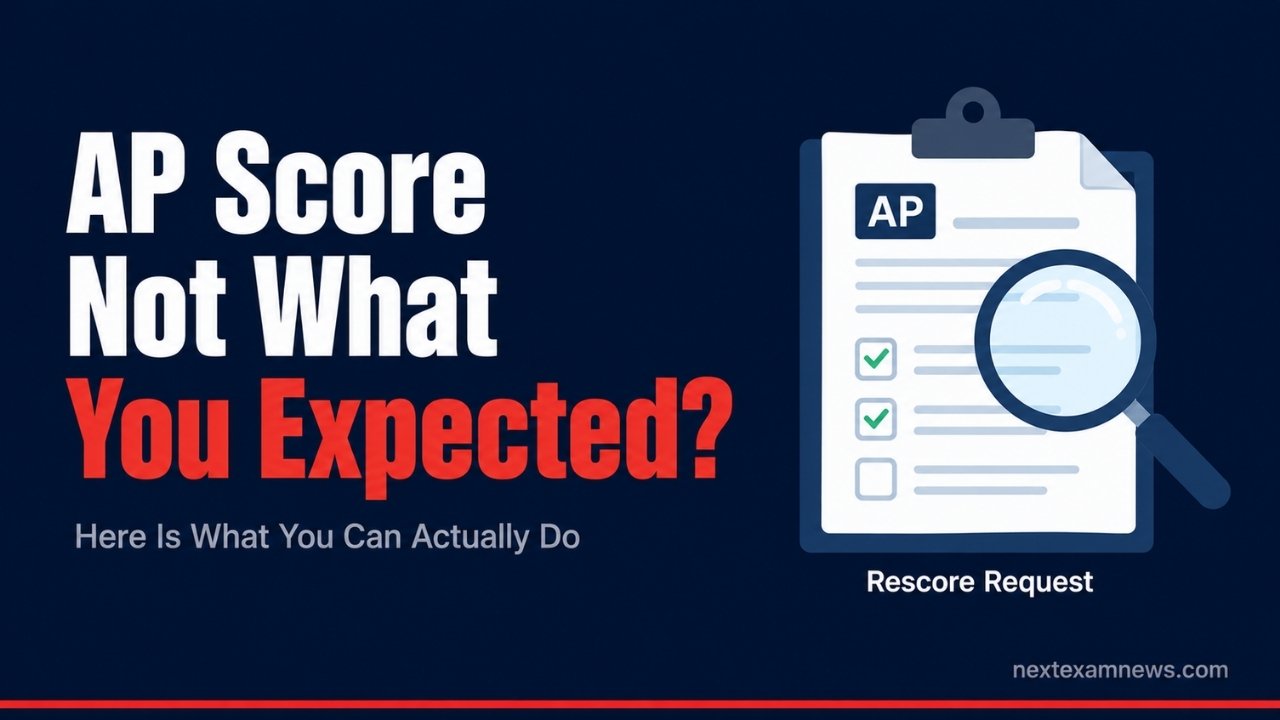
There is no formal appeal process for AP exam scores. What College Board does offer is a Multiple-Choice Rescore Service — a technical check of whether your answers were scanned and counted correctly. It costs $30 per exam, and the deadline to submit your request for 2026 exams is October 31, 2026. Your free-response answers cannot be rescored or appealed under any circumstances.
Getting a lower AP score than you expected is genuinely frustrating, especially if you put in serious work preparing for the exam.
The first thing many students search for after a disappointing score is how to appeal it. And the honest answer — one that most articles do not lead with clearly — is that College Board does not have a traditional appeal process for AP scores.
What does exist is more limited. There is a rescore service for the multiple-choice section of certain exams, and there are a few other options worth knowing about depending on your situation. This guide explains all of them, exactly how each works, and which one actually makes sense to pursue.
Why You Cannot Formally “Appeal” an AP Score
You cannot formally appeal an AP score. AP scores, unlike some other exams which do allow for re-marks, do not permit you to challenge the judgment of examiners or ask for your free-response answers to be regraded.
This surprises a lot of students because the word “appeal” gets used loosely in conversations about exam scores. In most contexts, an appeal means asking someone to take a second look at your work and reconsider the grade. That is not available for AP exams.
The reason comes down to how AP exams are scored. The multiple-choice section is scored by machine — it scans your answer sheet and counts correct responses. The free-response section is scored by trained human readers at the annual AP Reading conference in June. College Board considers both processes reliable and does not offer a pathway to have either re-evaluated on the merits of your answers.
What is available is a technical check to make sure your multiple-choice answers were recorded and counted correctly. This is not an appeal against your mark, but a verification of the scoring process itself.
Knowing the difference before you decide what to do next will save you time and the $30 fee.
What You Can Do — The Multiple-Choice Rescore Service
For a fee of $30 per exam, you may request to have your multiple-choice answer sheet rescored by hand. This is College Board’s official rescore service and the only formal review process available for AP scores.
Here is exactly what happens during a rescore:
Your original answer sheet is pulled and manually reviewed by College Board staff. They check whether your answers were correctly scanned and whether all responses were counted accurately. This is a technical process — the reviewer is not reading your answers and judging whether they are right or wrong. They are checking whether the machine correctly recorded what you bubbled in.
Rescores may result in higher or lower scores than first reported, or no change at all. Results are final and will automatically be re-reported to all designated score recipients if there was a change.
That last part is worth pausing on. If your score goes down after a rescore, that lower score becomes your official score and gets sent to every college you sent it to. You cannot reverse it.
Which Exams Are Eligible for a Rescore?
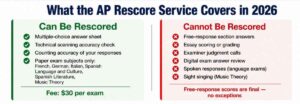
This is where many students get confused — not all AP exams qualify for the rescore service.
The multiple-choice rescore service can only be requested for paper and pencil exams: French Language and Culture, German Language and Culture, Italian Language and Culture, Spanish Language and Culture, Spanish Literature and Culture, and Music Theory.
If you took any other AP exam — including all digital exams delivered through Bluebook — the multiple-choice rescore service is not available. This means the vast majority of AP students in 2026 do not have access to this service, since most exams are now administered digitally.
If your exam is not on that list, the rescore service does not apply to you. Skip to the alternatives section below.
Step-by-Step — How to Request a Rescore for 2026
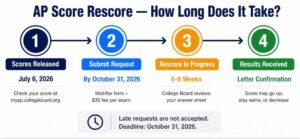
If your exam is eligible, here is the exact process:
Step 1 — Wait for your scores to be released. AP scores for 2026 exams are available starting July 6, 2026 through your College Board account at myap.collegeboard.org. Log in, review your scores, and decide whether you want to proceed with a rescore request.
Step 2 — Download the Multiple-Choice Rescore Service Form. Go to apstudents.collegeboard.org and navigate to Score Reporting Services. Download the official form — do not use any other form or third-party template.
Step 3 — Fill out the form accurately. Include your name, address, AP number, the exam you want rescored, and the year you took it. Double-check all information before submitting.
Step 4 — Pay the $30 fee per exam. The fee applies to each individual exam you want rescored. If you want two exams rescored, the fee is $60 total.
Step 5 — Submit by the deadline. Mail or fax the completed form to AP Services at P.O. Box 6671, Princeton, NJ 08541-6671, or fax to 610-290-8979. For 2026 exams, the request must be received by October 31, 2026.
Step 6 — Wait for your results. You will receive a letter confirming the results of the rescore 6 to 8 weeks after your request is received. If your score changed, College Board will automatically update your official record and re-report the new score to any colleges you previously sent it to.
Is Requesting a Rescore Actually Worth It?
For most students, the honest answer is probably not.
Because most AP scores depend heavily on free-response marking, rescoring often makes little difference unless there was a genuine technical error. An AP rescore is a technical review of the scoring process — not a re-mark of your exam.
The situations where a rescore might make sense are limited. If you are confident you answered a specific multiple-choice question correctly and believe there was a scanning or recording error, that is a reasonable basis for requesting a rescore. If your concern is about how your essays or free responses were graded, a rescore will not address that — and there is no way to have that section reviewed.
Before spending $30, consider whether a scanning error is realistically what happened. The vast majority of rescore results come back unchanged.
Other Options If a Rescore Does Not Apply to You
Review Your Free-Response Answers
If you want to review your answers to the free-response section, you can ask College Board to send a printed copy of the digital image of your AP Exam free response. This is available for most exams with free-response sections, including digital exams. No comments, corrections, or scores are included — and the responses are not rescored.
This option gives you the ability to see what you wrote, which can be useful for understanding your performance even if it does not change your score.
Withhold Your Score from Colleges
If your score is lower than you hoped and you do not want certain colleges to see it, you can withhold it. Withholding prevents that score from being sent to a specific school. It does not delete the score from your record.
The deadline to cancel your AP score — which permanently removes it from your record — was June 15, 2026. If that date has passed, cancellation is no longer an option for your 2026 scores. Canceling an AP score permanently deletes it and it cannot be reinstated at a later time.
Retake the Exam Next Year
You can retake the same AP exam the following year. Colleges typically consider your highest score, but policies vary. Some universities may see multiple attempts, so check the requirements in advance. Retaking gives you a fresh opportunity to improve with targeted preparation.
For most students who are genuinely unhappy with a score, retaking the exam in May 2027 is a more productive path than pursuing a rescore. You have nearly a full year to prepare, and you go into it knowing exactly which areas caught you off guard the first time.
Talk to Your AP Teacher Before July 31
If you scored a 1 or 2 and believe something went wrong with how your exam was handled — not scored, but administered — your AP teacher or coordinator can contact College Board on your behalf. This applies specifically to administrative issues, not grading disputes. This option closes quickly, typically by the end of July, so act fast if it applies to your situation.
What Happens to Your College Applications
If you already sent your AP scores to colleges before your score was updated through a rescore, College Board handles the update automatically.
Results are final and will automatically be re-reported to all designated score recipients if there was a change. You do not need to contact the colleges yourself. If your score went up, the updated score replaces the old one. If it went down, the lower score is what colleges will see going forward.
If you have not yet sent your scores and are waiting to see the rescore result first, that is a reasonable approach. Just keep college application deadlines in mind — AP scores are often supplemental materials, not primary requirements, but some programs do factor them into credit decisions.
Frequently Asked Questions
Can you appeal an AP exam score?
There is no formal appeal process for AP scores. You cannot challenge the judgment of examiners or request that your free-response answers be re-evaluated. What is available is a limited Multiple-Choice Rescore Service that checks whether your answers were correctly scanned and counted.
How much does the AP rescore service cost?
The fee is $30 per exam. If you want multiple exams rescored, the fee applies to each one individually.
What is the deadline to request an AP rescore for 2026 exams?
For 2026 AP exams, College Board must receive your rescore request by October 31, 2026. Late requests are not accepted.
Can my score go down after a rescore?
Yes. Rescores may result in higher or lower scores than first reported, or no change at all. Results are final. If your score decreases, that lower score becomes your official score. Think carefully before requesting a rescore if your current score is already acceptable for your purposes.
Can the free-response section of an AP exam be rescored?
No. Because your free-response section is scored manually to begin with, you may not request a rescore of the free-response section, nor may you appeal your score.
Which AP exams are eligible for a multiple-choice rescore?
The rescore service is only available for paper and pencil exams: French Language and Culture, German Language and Culture, Italian Language and Culture, Spanish Language and Culture, Spanish Literature and Culture, and Music Theory. Digital exams are not eligible.
How long does it take to get rescore results?
You will receive a letter confirming the results of the rescore 6 to 8 weeks after your request is received by College Board.
Should I retake the AP exam instead of requesting a rescore?
For most students, retaking the exam is the more practical option. Retaking gives you a fresh opportunity to improve with targeted preparation. A rescore only checks for technical scanning errors — it cannot improve a score that reflects actual performance on the exam. If you know the material well but performed below expectations, a retake with focused preparation is likely to produce better results than a rescore.
The Bottom Line
If you got a lower AP score than you expected, the rescore service is a narrow option that applies to specific paper exams and addresses only technical scanning errors. For most students taking digital AP exams in 2026, the rescore service does not apply at all.
Your real options are reviewing your free-response answers to understand where things went wrong, withholding or canceling your score if you do not want colleges to see it, or retaking the exam next May with a clearer picture of what to improve.
One score does not determine what happens next. It tells you something about where you are right now — and that information is actually useful if you let it guide your next step rather than just trying to undo it.
Official Resources:
- AP Score Reporting Services: apstudents.collegeboard.org/score-reporting-services
- Multiple-Choice Rescore Request Form: apstudents.collegeboard.org/request-rescore
- View AP Scores: myap.collegeboard.org