

A good SAT score in 2026 is 1200 or higher, which places you at the 75th percentile — meaning you scored better than three out of four test-takers. The national average is approximately 1050. A score of 1400+ is excellent and competitive for top-50 schools. For Ivy League admissions, aim for 1500 or above. What counts as “good” ultimately depends on which colleges you are applying to.
If you just got your SAT scores back — or you are planning to take the exam and want to know what to aim for — the first thing to understand is that there is no single “good” score.
A 1200 might be more than enough for one student’s college list and fall short for another’s. It all depends on where you are applying and what you are trying to accomplish.
This guide breaks down SAT score ranges, national percentiles, section benchmarks, and exactly what scores are competitive at different college tiers — so you can figure out what “good” actually means for your specific goals.
The SAT Score Scale — How It Works
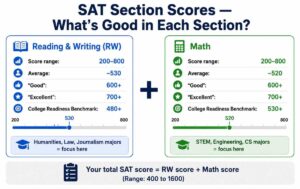
The SAT is scored on a scale of 400 to 1600. Your total score is made up of two sections:
- Reading and Writing (RW): Scored 200–800
- Math: Scored 200–800
Add the two section scores together and you get your composite score between 400 and 1600.
For example: If you score 640 in Reading and Writing and 620 in Math, your total SAT score is 1260.
The maximum SAT score is 1600 — often called a perfect SAT score. It is the highest score possible and a very strong result for college admissions, though not a guarantee of admission at the most selective schools.
Since 2024, the SAT is fully digital. The adaptive format means your Module 2 difficulty adjusts based on Module 1 performance. This makes the raw-to-scaled score conversion different from the old paper SAT. The scoring scale itself, however, has not changed.
What Is the Average SAT Score in 2026?
The average SAT score for the 2025–2026 testing cycle is approximately 1050 out of 1600. This breaks down to roughly 530 in Reading and Writing and 520 in Math. The Digital SAT format has kept this average relatively stable compared to the old paper test.
If your score is above 1050, you have already outperformed more than half of all test-takers nationwide.
But here is the honest reality — for students applying to selective colleges, being above average is not enough. The students competing for spots at state flagships, top-50 universities, and Ivy League schools score significantly above the national average. That is what the percentile breakdown below helps you understand.
SAT Score Percentiles — Where Do You Actually Stand?
Your SAT percentile tells you what percentage of test-takers scored lower than you. It is the most honest way to understand how competitive your score actually is.

| SAT Score | Percentile | What It Means |
|---|---|---|
| 1600 | 99th+ | Perfect score — top of every applicant pool |
| 1550 | 99th | Outstanding — Ivy League competitive |
| 1500 | 99th | Excellent — strong for top-20 schools |
| 1450 | 97th | Very strong — competitive for top-50 schools |
| 1400 | 95th | Excellent — beats 95% of all test-takers |
| 1350 | 91st | Very good — solid for competitive state schools |
| 1300 | 87th | Good — competitive for many colleges |
| 1200 | 75th | Good — above most state school ranges |
| 1100 | 59th | Above average — suitable for many colleges |
| 1050 | 50th | National average |
| 900 | 27th | Below average — limited competitive options |
| 750 | 5th | Well below average |
Source: College Board 2025 percentile data for college-bound seniors
You only need to score 1350 on the SAT to be within the top 10% of test-takers. Contrary to what you might expect, a perfect 1600 is not required to get an excellent score — you do not even need to break 1400. On the other hand, a score of 750 or below puts you in the bottom 10% of test-takers and will not look very strong on college applications.
Good SAT Scores by College Tier — 2026
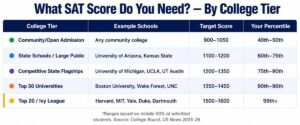
The most practical way to evaluate your score is to compare it against the colleges you actually want to attend. Here is what is competitive at each tier:
| College Tier | Target SAT Score | Percentile |
|---|---|---|
| Community College / Open Admission | 900–1050 | 27th–50th |
| State Schools / Large Public Universities | 1100–1200 | 59th–75th |
| Competitive State Flagships (UT Austin, UNC, UCLA) | 1200–1350 | 75th–91st |
| Top 50 Universities | 1350–1450 | 91st–97th |
| Top 20 Universities (Duke, Northwestern) | 1450–1550 | 97th–99th |
| Ivy League (Harvard, Yale, Princeton, MIT) | 1500–1600 | 99th+ |
For Ivy League schools like Harvard, Yale, and Princeton, a competitive SAT score is 1500 or higher. A score of 1550 or above is considered strong for these highly selective institutions.
A good target range for Ivy League schools is generally 1450 to 1550 to stay within the middle 50% range of admitted students, and 1500 or higher to be considered highly competitive, especially if applying to selective majors or programs. Keep in mind that a strong score alone will not guarantee admission.
Good SAT Scores by Section — Reading & Writing vs Math
Your section scores matter — not just your total. Some colleges and majors weight individual sections differently.
Reading and Writing (RW) — Scored 200 to 800
A score of 600 to 680 is a strong ERW score, generally placing students between the 74th and 90th percentiles. A score of 700 to 800 is highly competitive, often seen among applicants to selective universities. Strong ERW scores may be particularly valuable for students pursuing majors in humanities, journalism, political science, or other writing-intensive fields.
Math — Scored 200 to 800
A score around 500 is close to the national average Math score. For STEM majors — engineering, computer science, mathematics — most competitive programs want to see Math scores of 700 or above. For non-STEM majors, a strong Math score is still valuable but slightly less critical than your Reading and Writing performance.
College Readiness Benchmarks
SAT benchmarks are based on real student performance data and indicate your likelihood of success in college. Scoring 480 or above in Reading and Writing means you have a 75% chance of earning at least a C in first-semester college courses like history, literature, and social sciences. Scoring 530 or above in Math means you have a 75% chance of earning at least a C in college-level math courses such as algebra, statistics, or calculus.
Meeting these benchmarks means you are college-ready. Exceeding them is what makes you competitive for selective admissions.
The Test-Optional Question — Does Your SAT Score Still Matter?
This is one of the most common questions students ask in 2026, and the landscape has shifted significantly.
The test-optional movement that began during the COVID pandemic has largely stabilized by 2026. While hundreds of colleges remain test-optional, many elite universities have returned to requiring standardized test scores — including Harvard, Yale, Dartmouth, Brown, MIT, Georgetown, and others that now mandate SAT or ACT submission.
So what should you do? Here is the practical guide:
If your score is at or above the school’s middle-50% range: Submit it. A strong score only helps your application and can strengthen your case for merit scholarships.
If your score is below the school’s 25th percentile: Consider going test-optional for that specific school. Your application may be stronger without a low score attached.
If your score falls between the 25th and 50th percentile: This is a judgment call. If the rest of your application is strong — high GPA, unique extracurriculars — submitting may still be beneficial as it shows transparency.
What Is a Good SAT Score for Scholarships?
Beyond admissions, SAT scores play a major role in merit scholarship eligibility — and this is where a strong score can translate directly into money.
Most major merit scholarships have SAT score thresholds. Here are general benchmarks:
| Scholarship Type | Typical SAT Requirement |
|---|---|
| National Merit Scholarship (Commended) | ~1400+ depending on state |
| National Merit Semifinalist | ~1520+ (varies by state) |
| University Honors Programs | 1300–1400+ typically |
| Full-Ride Merit Scholarships | 1400–1500+ at most schools |
| Partial Merit Scholarships | 1200–1350 at many schools |
Even at test-optional schools, submitting a strong score can unlock scholarship consideration that is not available to students who do not submit. Always check the specific scholarship requirements at each school you are applying to.
Should You Retake the SAT?
Whether to retake depends on three things: your current score, your target schools, and how much room for improvement exists.
If your target schools have middle-50% ranges below 1400, retaking may not significantly improve your chances. However, if you are applying to highly selective schools where 1400 is at or below the 25th percentile, even a 30 to 50 point improvement could strengthen your application.
Most students take the SAT two to three times. Taking it more than three times rarely yields significant additional improvement and can signal to some admissions officers that you are not using your time wisely. Since most schools superscore — meaning they take your highest section scores across all test dates — each attempt lets you potentially improve individual sections.
The recommended plan: take the SAT once in the spring of junior year, once in the fall of senior year, and a third time only if there is clear room for improvement in a specific section.
SAT Score Release Dates 2026 — When Will You Get Your Score?
If you recently took the SAT and are waiting on results, here is the typical timeline:
| Test Date | Score Release Date |
|---|---|
| March 8, 2026 | March 28, 2026 |
| May 3, 2026 | May 16, 2026 |
| June 7, 2026 | June 20, 2026 |
| August 29, 2026 | September 11, 2026 |
| October 3, 2026 | October 17, 2026 |
| November 7, 2026 | November 18, 2026 |
| December 5, 2026 | December 19, 2026 |
Scores are released through your College Board account at collegeboard.org. You will receive an email notification when your score is available. Digital SAT scores are typically available within two weeks of your test date.
Frequently Asked Questions
What is a good SAT score in 2026?
A good SAT score in 2026 is 1200 or higher, which puts you at the 75th percentile. A score of 1400 or above is excellent and competitive for top-50 schools. For Ivy League admissions, aim for 1500 or above. The average SAT score is approximately 1050, which falls at the 50th percentile.
What is the average SAT score in 2026?
The average SAT score for the 2025–2026 testing cycle is approximately 1050 out of 1600. This breaks down to roughly 530 in Reading and Writing and 520 in Math.
Is 1200 a good SAT score?
Yes — 1200 places you at the 75th percentile, meaning you scored higher than 75% of all test-takers. It is competitive for many state universities and large public schools. However, for selective colleges with middle-50% ranges above 1350, a 1200 would fall below the typical admitted student range.
Is 1400 a good SAT score?
A 1400 is an excellent score — it places you at the 95th percentile. A score of 1400 or above is competitive for top-50 schools. For most students, a 1400 is a very strong result that opens doors to a wide range of selective universities and merit scholarships.
What SAT score do you need for Harvard?
For Ivy League schools like Harvard, Yale, and Princeton, a competitive SAT score is 1500 or higher. A score of 1550 or above is considered strong for these highly selective institutions. The middle 50% of admitted Harvard students typically score between 1480 and 1580.
Is a 1100 SAT score good enough for college?
A 1100 places you at around the 59th percentile — above the national average and acceptable at many colleges. It is competitive for less selective state schools and community colleges. However, for competitive state flagships and selective universities, you would want to aim higher.
How many times should I take the SAT?
Most students take the SAT two to three times. Taking it more than three times rarely yields significant additional improvement. Since most schools superscore, each attempt lets you potentially improve individual sections. Plan to take it once in junior year spring and once in senior year fall.
Does my SAT score matter if a school is test-optional?
It depends on your score. If your SAT score is at or above the school’s middle-50% range, submitting it can only help your application — and it may also qualify you for merit scholarships that require score submission. If your score falls below the 25th percentile for your target school, going test-optional may be the stronger choice.
Bottom Line — What Score Should You Aim For?
Here is a simple framework to decide what a “good” SAT score is for you:
Step 1: Look up the middle-50% SAT range for each college on your list. Find this on the school’s Common Data Set or College Board BigFuture page.
Step 2: Aim for the 75th percentile score for your target schools — not the 25th. Being in the upper half of admitted students’ score ranges puts you in a stronger position for admission and scholarships.
Step 3: If your current score falls below your target, decide whether the gap is closeable with focused preparation before your next test date.
The national benchmarks give you context. But your target college’s specific numbers are what actually matter for your application.
Official Resources:
- College Board SAT Scores: collegeboard.org/scores
- SAT Percentile Data: satsuite.collegeboard.org
- College BigFuture (school score ranges): bigfuture.collegeboard.org
- SAT Score Release Dates: satsuite.collegeboard.org — Score Dates
Last Updated: May 6, 2026. Percentile data is based on College Board’s most recently published annual report for college-bound seniors. Score ranges by college tier are approximate and based on publicly reported middle-50% ranges. Always check the specific SAT requirements and score ranges directly on each college’s admissions page before making decisions.