
If roughly half of first-time CPC candidates fail, there is a reason — and it is not that the content is impossible.
Most CPC failures come down to time management and poor code book navigation, not a lack of coding knowledge.
This guide breaks down the actual pass rate data, what makes the exam genuinely hard, every cost you will face, and exactly how the retake system works in 2026.
CPC Exam — Key Facts for 2026
| Detail | Information |
|---|---|
| Certifying Body | AAPC (American Academy of Professional Coders) |
| Total Questions | 100 multiple-choice questions |
| Time Limit | 4 hours — 2.4 minutes per question average |
| Passing Score | 70% — you must answer at least 70 of 100 questions correctly |
| Exam Format | Open-book — approved code manuals permitted |
| Content Sections | 17 sections covering all major coding domains |
| Results Timeline | 7 to 10 business days — available on My AAPC dashboard |
| First-Time Pass Rate | Estimated 50–60% (AAPC does not publish official data) |
| Delivery | In-person at Pearson VUE centers or online with remote proctor |
Also Read: June 2026 NY Regents Score Release Date: How to Check Official Portals
The Real Pass Rate — What the Data Actually Shows
AAPC does not publish official CPC exam pass rates.
That alone is worth noting. For a certification exam this widely taken, the absence of official data is unusual.
Industry estimates, compiled from training program reports, AAPC forum discussions, and community surveys, paint a consistent picture.
| Candidate Type | Estimated Pass Rate |
|---|---|
| Candidates with formal training programs | 65–75% first attempt |
| Self-study candidates | 35–50% first attempt |
| Overall first-time estimate | 50–60% |
| Eventual pass rate across all attempts | 70–80% |
The gap between formal training and self-study candidates is significant. Roughly 4 to 5 out of 10 first-time test-takers fail the CPC exam.
The good news: most who fail and retake with a structured plan do pass. Most second-attempt candidates pass with comfortable margins because they finally know what the exam looks like.
Why the CPC Exam Is Harder Than It Looks
This is an open-book exam. That description misleads a lot of first-time candidates into thinking it is easier than it is.
The exam does not test whether you have memorized codes. It tests whether you can navigate three thick code books, apply guidelines correctly, and choose the single best answer when two options look nearly identical — all within 2.4 minutes per question on average.
Most CPC failures are not knowledge failures — they are time failures.
The math explains why. Surgical coding questions take 3 to 5 minutes each. E/M questions take 2 to 4 minutes each. ICD-10-CM questions take only 1 to 2 minutes each.
A candidate who spends 5 minutes on each surgery question will run out of time before reaching the easier sections at the end.
Hardest Sections
Surgery subsections are consistently ranked as the most time-consuming and the most failed area on the exam. Surgery subsections account for approximately 25% of the exam combined.
E/M coding is the second most challenging area for most candidates. E/M coding accounts for 14% of the exam. The 2021 documentation guideline changes — based on Medical Decision Making rather than history and physical components — are frequently tested and frequently missed.
ICD-10-CM accounts for 15% of the exam and is generally more straightforward for candidates who have practiced with the code book consistently.
The Code Book Problem
Candidates are allowed to bring their CPT, ICD-10-CM, and HCPCS Level II code books to the exam.
This is only an advantage if those books are properly organized. AAPC allows tabs, sticky notes, and handwritten notes in your code books. Tabbing your books is the single most valuable prep activity besides taking practice questions.
Current means the version effective for the year you are testing. If you are sitting the exam in 2026, you need 2026 code books. Old editions are rejected at check-in.
Complete Cost Breakdown
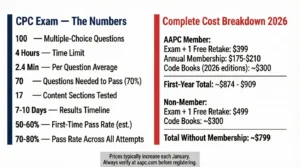
Every CPC candidate faces two separate cost decisions — membership and exam registration.
| Item | AAPC Member | Non-Member |
|---|---|---|
| Exam + One Free Retake | $399 | $499 |
| Annual AAPC Membership | $175–$210/year | Not applicable |
| 2026 Code Books (CPT + ICD-10-CM + HCPCS) | ~$300 new | ~$300 new |
| First-Year Total Estimate | ~$875–$910 | ~$800 |
| Additional Retakes After Free One | $399 each | $499 each |
Prices typically increase each January. Always verify the current exam fee at aapc.com before registering.
The math on membership: if you plan to maintain certification long-term, joining as a member before registering for the exam saves $100 on the first sitting and provides ongoing access to CEU resources, discounted study materials, and member pricing on specialty credentials.
Also Read: California NCLEX Retake Policy 2026: Mandatory Waiting Periods & Board Fees
Retake Rules — How They Actually Work
The CPC retake policy is considerably more lenient than exams like the NCLEX or Bar Exam.
The CPC passing score is 70%. Retakes have no wait period and are unlimited.
Every exam purchase — whether the $399 member price or $499 non-member price — includes one free retake within 12 months.
You can take the exam as many times as you need to pass it. There is no annual attempt limit and no lifetime cap.
After using your free retake, each additional attempt requires purchasing a new exam voucher at full price.
What You Get After Failing
AAPC does not give you your numeric score when you fail. What you receive is more useful.
If you do not pass, you will be notified of the subjects or areas of study with scores of 65 percent or less to assist you in preparing for retesting.
This section-by-section report tells you exactly where your preparation was weakest. Use it to build your retake study plan around specific sections — not a general review of everything.
The CPC-A Designation — What Happens Without Experience
Passing the CPC exam does not automatically give you full CPC status.
AAPC recommends two years of professional coding experience for full CPC certification. Candidates who pass the exam without meeting the experience requirement receive the CPC-A (Apprentice) designation instead of full CPC status.
The “A” is not a barrier to employment. The CPC-A still qualifies you for most entry-level medical coding positions. Many employers hire CPC-A holders and support them through the apprentice period.
To remove the “A” designation: the “A” drops off your credential as soon as you document two years of work experience or one year of experience plus 80 hours of approved coding coursework.
Maintaining Your CPC After Passing
Once you pass the CPC exam, you do not have to retake the exam again as long as you submit 36 CEUs to AAPC every two years.
If inactivity extends beyond two years, AAPC may require you to retake the exam to reactivate, so calendar your renewal date and CEU upload deadlines well in advance to avoid expensive surprises later.
Career Outlook — Is the CPC Worth the Cost
The medical coding market is projected to grow at a CAGR of 10% from 2025 to 2033.
Medical coding jobs are projected to grow 9% through 2033 (BLS).
The CPC is the most widely recognized outpatient coding credential in the country. Employers in hospital systems, physician offices, insurance companies, and coding consulting firms specifically list it as a preferred or required qualification.
The total first-year investment of $875 to $910 is recoverable within weeks of landing a certified coding role — median salaries for CPC holders typically range from $45,000 to $65,000 depending on experience, specialty, and location.
Frequently Asked Questions
What is the AAPC CPC exam pass rate in 2026?
AAPC does not publish official CPC exam pass rates. Industry estimates place the first-time pass rate at 50 to 60 percent overall. Candidates completing formal training programs pass at 65 to 75 percent, while self-study candidates pass at 35 to 50 percent on the first attempt.
How much does the CPC exam cost in 2026?
The CPC exam costs $399 for current AAPC members and $499 for non-members. Both prices include one free retake within 12 months. Annual AAPC membership costs $175 to $210 per year. New 2026 code books add approximately $300.
Is there a waiting period to retake the CPC exam?
No. The CPC retake policy has no mandatory waiting period between attempts and allows unlimited retakes. Every exam purchase includes one free retake within 12 months. Additional attempts beyond that require purchasing a new exam voucher.
What score do you need to pass the CPC exam?
You need a score of 70 percent or higher — at least 70 correct answers out of 100 questions. The exam scores overall performance only. You do not need 70 percent in every individual section.
Why do so many people fail the CPC exam?
Most CPC failures are time failures, not knowledge failures. Surgical coding questions take 3 to 5 minutes each, and E/M questions take 2 to 4 minutes each — yet the exam allows only 2.4 minutes per question on average. Poor code book organization and slow navigation are the most common causes of running out of time.
What happens if I pass the CPC without 2 years of experience?
You receive the CPC-A (Apprentice) designation instead of full CPC status. The “A” drops off as soon as you document two years of work experience or one year of experience plus 80 hours of approved coding coursework. Most entry-level employers hire CPC-A holders.
Are code books allowed during the CPC exam?
Yes. The CPC is an open-book exam. You may bring your CPT Professional Edition, ICD-10-CM, and HCPCS Level II code books. AAPC allows tabs, sticky notes, and handwritten notes. You must bring 2026 editions — old editions are rejected at check-in.
How long does it take to get CPC exam results?
CPC exam results are usually available within 7 to 10 business days. Candidates can check their scores on the My AAPC account dashboard.
Official Resources:
- AAPC CPC Exam Registration: aapc.com/certifications/cpc
- AAPC Membership: aapc.com/membership
- Schedule at Pearson VUE: pearsonvue.com/aapc
- BLS Medical Records Outlook: bls.gov — Medical Coding Career Outlook
Last Updated: June 30, 2026.