

Matrix Multiple-Response questions on the 2026 NCLEX use “plus/minus” scoring, meaning every wrong box you check subtracts a point you already earned. This is different from Matrix Multiple-Choice, which uses simple 0/1 scoring with no penalty at all. Below, you’ll find NCSBN’s official scoring formulas, a worked example, and the row-by-row strategy that actually protects your points.
What Is the Difference Between the Two Matrix Question Types?
Not every matrix question on the NCLEX is scored the same way.
The exam uses two distinct grid formats, and mixing them up is the biggest source of candidate confusion.
Matrix Multiple Choice asks you to pick one answer per row.
Matrix Multiple Response asks you to check every box that applies, in one or more rows.
The National Council of State Boards of Nursing confirms these two formats use completely different math.
Matrix Multiple Choice vs. Matrix Multiple Response
| Feature | Matrix Multiple Choice | Matrix Multiple Response |
|---|---|---|
| Selections per row | One answer only | Any number of boxes |
| Scoring model | 0/1 scoring | Plus/minus (+/-) scoring |
| Penalty for a wrong pick | None | Yes, one point subtracted |
| How the row is scored | Independently, then summed | Independently, then summed |
| Maximum item score | Equal to number of rows | Equal to number of correct options |
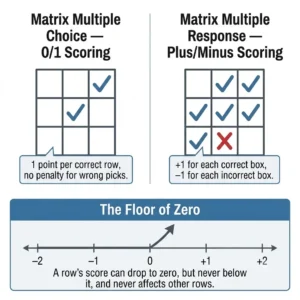
<cite index=”16-1″>Under 0/1 scoring, each row of a matrix multiple-choice item is scored independently, and the row scores are added together for the total item score.</cite> <cite index=”16-1″>No penalty applies for selecting a wrong option in this format.</cite>
Matrix Multiple Response works differently. <cite index=”16-1″>Points are earned for correct selections, and points are subtracted for incorrect selections, with the item’s total score equal to correct selections minus incorrect ones.</cite>
That subtraction is exactly what’s fueling the panic on nursing forums this year. The old test-prep habit of “when in doubt, select it anyway” can actively erase points on this format.
Does a Wrong Answer Ever Wipe Out Your Whole Score?
No. NCSBN builds a safety net directly into the plus/minus formula.
<cite index=”16-1″>Any total score that works out negative for a matrix multiple-response column or row is rounded up to zero.</cite>
In plain terms: your score for that specific row or column can hit zero, but it cannot go below zero and it cannot pull points away from a different row.
<cite index=”16-1″>Each column or row in a Matrix MR item is scored independently, so a negative result in one section does not spill over and reduce the score of a neighboring row or column.</cite>
This is confirmed directly on NCSBN’s official candidate help center, not a third-party estimate. It means one over-selected row can only cost you the points available in that row — never the whole item, and never points you earned on a different question entirely.
How Are Matrix/Grid Questions Actually Laid Out?
Picture a table with clinical findings listed down the left side and categories listed across the top.
<cite index=”21-1″>According to NCSBN’s own NGN candidate FAQs, a matrix item can present as many as eight rows, each requiring the candidate to choose from three answer columns.</cite>
The row count and column count both vary by question. Some matrix items are much smaller.
What stays constant is how the grid is graded. Every row is treated as its own mini-question.
<cite index=”16-1″>Matrix MR scores are summed across whichever direction the item is structured around, either columns or rows, and each of those columns or rows is graded on its own.</cite>
This is the detail most test-prep advice glosses over. One alarming finding in row 3 should not change how you answer row 6.
The grid is testing whether you can isolate each piece of clinical data and judge it on its own merits, not whether you can spot one dramatic theme and apply it everywhere.
Should You Still Guess on Matrix Multiple-Response Questions?
The strategy that worked on classic Select-All-That-Apply doesn’t fully transfer here, and understanding why comes down to simple math.
On a row where you are confident about two correct findings and unsure about a third, selecting only the two you can defend protects the points you’ve already earned.
Adding the uncertain third option only helps if it turns out to be correct. If it’s wrong, it subtracts from that same row.
Because each row cannot fall below zero, an unsupported guess never costs you points from a different row. But it can still flatten the row you’re guessing on.
A useful test before checking any box: can you explain, in one clinical sentence, why that specific finding belongs in that specific row? If not, leave it unchecked.
This isn’t about avoiding the question. It’s about only spending your “checks” where the evidence in the case actually supports them.
Where Does This Fit Into the Broader 2026 NCLEX-RN Test Plan?
<cite index=”27-1″>NCSBN members approved the 2026 NCLEX-RN and NCLEX-PN test plans at the Annual Meeting held August 13–15, 2025.</cite> <cite index=”26-1″>The 2026 NCLEX-RN Test Plan takes effect April 1, 2026, and remains in place through March 31, 2029.</cite>
Partial-credit scoring for Next Generation NCLEX items isn’t new for 2026 — it launched with the original NGN rollout. What’s new is candidates encountering it at scale as unfolding case studies become a bigger share of the exam under the updated plan.
Important Links
| Resource | Link |
|---|---|
| Official Scoring Models Explainer | Read NCSBN’s Scoring Models FAQ |
| 2026 NCLEX-RN Test Plan (PDF) | Download the Official Test Plan |
| NCLEX Test Plans Hub | View All Official Test Plans |
| NCSBN Official Website | Visit NCSBN.org |
| NCLEX Candidate Resources | Explore Official NCLEX.com Resources |

Meet Deepkant Shrivastava, a Senior Education Insights Analyst and the Lead Content Strategist at NextExamNews. Since 2020, he has tracked, analyzed, and broken down complex state licensing pipelines, standardized testing algorithms, and career guidelines across over ten major educational platforms.
Specializing in high-stakes professional examinations like the NCLEX, Praxis, and IT certifications, Deepkant leverages data-driven research and performance metrics to provide real-time updates on system glitches, scoring matrix changes, and state board rules. His primary mission is to transform dense, anxiety-inducing institutional updates into transparent, actionable, and straight-to-the-point guides for career-driven students.