

The national first-time NCLEX-RN pass rate for U.S.-educated candidates dropped to 86.7% in 2025, down from 91.2% in 2024, according to the National Council of State Boards of Nursing. That gap matters because a school below 80% can face state review, and the drop signals real changes in how programs are preparing graduates. Here’s how to read your own school’s numbers.
What Is the National NCLEX Pass Rate Right Now?
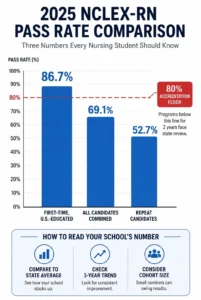
NCSBN’s 2025 Examination Statistics brief puts the picture in three numbers.
- 86.7% — first-time, U.S.-educated NCLEX-RN candidates
- 69.1% — all NCLEX-RN candidates combined, including repeat and internationally educated test-takers
- 52.7% — repeat, U.S.-educated candidates
The 86.7% figure is the one most relevant to a recent graduate testing for the first time.
The 69.1% “overall” figure gets quoted more often in headlines, but it blends in a much larger pool of repeat and international test-takers.
Why Did Pass Rates Fall in 2025?
The first-time U.S.-educated rate fell from 91.2% in 2024 to 86.7% in 2025.
It’s the first meaningful pullback since the Next Generation NCLEX (NGN) launched in April 2023.
Three factors are driving it, according to nursing educators and test-prep analysts.
A larger, more varied candidate pool. More repeat and internationally educated test-takers are sitting the exam, which pulls down blended averages even when first-time performance holds steady.
Lingering pandemic-era clinical gaps. Many 2025 and 2026 graduates had disrupted clinical rotations early in nursing school, which the NGN’s clinical-judgment questions are designed to catch.
A “false security” effect. Strong 2024 results may have led some programs and students to underprepare for how demanding the NGN clinical-judgment format actually is.
How Should You Read Your School’s Pass Rate?
A single number means little without context. Compare it against three benchmarks.
| Benchmark | What It Tells You |
|---|---|
| National first-time average (86.7%, 2025) | Whether your program is above or below typical performance |
| Your state’s average | State boards set their own thresholds, so state comparisons matter more than national ones |
| Three-year trend for your program | One bad year can be a fluke; three years below average is a pattern |
A program at 85% in a state averaging 91% is underperforming its peers, even though 85% looks fine on its own.
Cohort size matters too. A program with 10 graduates and a 100% pass rate isn’t necessarily stronger than one with 200 graduates at 94%.
Why Does the 80% Threshold Matter?
Most state boards of nursing treat an 80% first-time pass rate as a minimum floor, not a mark of excellence.
Accreditors ACEN and CCNE generally expect programs to stay at or above that level.
Programs that fall below 80% for two consecutive years typically trigger a state review.
That review can lead to a required improvement plan, provisional approval, or in serious cases, loss of approval to admit new students.
The exact rule varies by state:
- Louisiana — 80% threshold; falling below it for two of the last three years brings probation.
- Ohio — a stricter 95% first-time benchmark; missing it starts an improvement-plan process.
- Florida — a dual test: no more than 10 points below the national average, with an absolute 30% floor; funding can be affected.
Because the rules differ, always check your own state board’s published standard rather than assuming 80% applies everywhere.
Do Nursing Schools Manipulate Their Pass Rates?
This is a common concern among students researching programs, and it deserves a direct answer.
Some students and online discussions allege that certain programs use harsh internal grading or mandatory “exit exams” late in the curriculum to filter out weaker students before they reach the NCLEX.
NextExamNews has not found an official NCSBN or state board dataset that confirms this practice program-by-program.
What is documented is this: a program with a high graduation-to-pass-rate ratio, but a low admission-to-graduation ratio, deserves closer scrutiny.
If a school admits 150 students but graduates only 30, a 95% NCLEX pass rate should be read with caution.
Ask any program directly about its admission, retention, and graduation numbers, not just its NCLEX pass rate.
What’s Changing on the NCLEX in April 2026?
A new NCSBN test plan takes effect April 1, 2026, and runs through March 2029.
Anxious students should know this upfront: the passing standard is not changing.
The update is a routine three-year refresh, not a redesign. NCSBN confirms the content categories, percentage weightings, and CAT scoring method all stay the same.
The visible changes are mostly naming updates:
- “Safety and Infection Control” becomes “Safety and Infection Prevention and Control.”
- “Substance abuse” becomes “substance misuse.”
- New activity statements reinforce equitable care, client dignity, and confidentiality, including around social media disclosure.
If you’re testing after April 1, 2026, you do not need a different study plan than someone testing in March 2026.
Quick Facts: 2025 NCLEX-RN Pass Rates
- National first-time, U.S.-educated rate: 86.7% (down from 91.2% in 2024)
- Overall rate, all candidate types: 69.1% (down from 73.3% in 2024)
- Repeat candidate rate: 52.7%
- Most common state accreditation floor: 80% first-time pass rate
- Next test plan update: April 1, 2026 (minor wording changes only)
Frequently Asked Questions
What is a good NCLEX pass rate for a nursing school?
Programs consistently at or above the national first-time average, currently around 86–87%, are considered strong performers. Anything below 80% over multiple years warrants closer questions.
Is a below-average pass rate always a reason to avoid a school?
Not automatically. Check the state average too, since a school can sit below the national number while still leading its own state.
Does a low pass rate affect my ability to get licensed?
No. Your individual NCLEX result determines your own licensure. A program’s pass rate is a signal about preparation quality, not a rule that governs your outcome.
Will the April 2026 test plan make the NCLEX harder?
No. NCSBN has confirmed the passing standard, content weighting, and question formats are unchanged. The update mainly renames a few categories.
Where can I find my specific school’s pass rate?
Your state board of nursing publishes program-level data, and NCSBN’s annual Examination Statistics report breaks down national and state figures by candidate type.
Important Links
| Resource | Link |
|---|---|
| NCSBN Official Website | Visit Official Website |
| 2025 NCLEX Examination Statistics | View Official Report |
| NCLEX Exam Statistics & Publications Hub | Browse Official Statistics |
| NCLEX Program Reports (for nursing programs) | Learn About Program Reports |

Meet Deepkant Shrivastava, he has been writing content since 2020. Over the years he has worked across more than ten websites — mostly covering job updates, career guidance, and government schemes — which gave him a solid grip on how to break down complicated topics for everyday readers.
At NextExamNews, he writes guides, exam updates, and result-related articles covering major about various exams. He tries to keep every article easy to read and straight to the point.
On the personal side, he is currently in performance marketing domain and learning AI and finding ways to bring both into his content creation.