

What Is the Pearson VUE Trick?
The Pearson VUE Trick, often shortened to PVT, is an unofficial way candidates try to preview their NCLEX result.
After finishing the exam, candidates log back into their Pearson VUE account and attempt to register for the NCLEX again.
The system’s response to that attempt has become known, informally, as a signal of whether the candidate passed or failed.
This trick has never been created, confirmed, or endorsed by Pearson VUE or the National Council of State Boards of Nursing (NCSBN).
What Do the “Good” and “Bad” Pop-Ups Actually Say?
Candidates describe two general outcomes when they attempt to re-register.
| Outcome | What Typically Happens |
|---|---|
| “Good” pop-up | The system blocks the new registration, stating the candidate already has a recent exam on file and cannot register again at this time. |
| “Bad” pop-up | The system allows the registration to continue through to the payment page and attempts to process a $200 exam fee. |
The theory behind the trick is simple. If your result was recorded as a pass, your account should be locked out of re-registering, since you have no reason to retest.
If your result was recorded as a fail, the system treats you as eligible to test again, so it lets the registration proceed.
Why Are Candidates Now Seeing a Pending $200 Charge Alongside a Good Pop-Up?
This is the detail causing the most confusion right now.
Some candidates report entering their card details, receiving the reassuring “good pop-up” message, and still seeing a $200 charge appear on their bank app minutes later.
That combination feels contradictory. A good pop-up is supposed to mean the registration was blocked, so why would a charge show up at all?
Here is the most likely explanation, based on how card payment systems generally work.
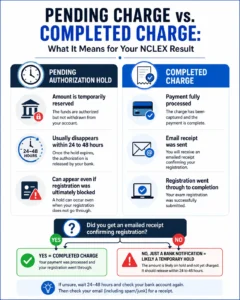
Many online payment forms place a temporary authorization hold on a card the moment card details are submitted, before the merchant’s system confirms whether the underlying transaction will actually go through.
That hold can appear on your bank statement as a “pending” charge even if the registration itself is ultimately rejected.
Neither Pearson VUE nor the NCSBN has published a public statement confirming a specific system change behind this pattern.
Until one of them does, this remains the most plausible technical explanation, not a confirmed official one.
Does a Pending Charge Mean You Failed the NCLEX?
No. A pending charge by itself does not confirm a failing result.
A pending charge only confirms that a card authorization was requested at some point during the registration attempt.
What actually matters is whether the registration fully completed or whether the system blocked it with the “good pop-up” message.
If you received the good pop-up message and the charge later disappears from your account without ever posting as a final transaction, that is consistent with a temporary hold, not a completed payment.
If you received a confirmation that your new exam registration was successful, that is the traditional signal associated with a failing result.
How Long Should You Wait Before Trying the Trick?
Timing matters more than most candidates realize.
Your exam result is not immediately final the moment your screen goes dark at the testing center.
Most experienced sources recommend waiting at least two to four hours after your exam ends before attempting the trick.
Some candidates wait even longer, up to 24 hours, to reduce the risk of a false result caused by incomplete data processing.
Trying the trick too early increases the chance of getting a “results on hold” message that means nothing yet, not a real answer.
Is the Pearson VUE Trick Officially Accurate?
No official body has ever confirmed the trick’s accuracy.
Pearson VUE and the NCSBN do not officially endorse, explain, or guarantee this method.
Community reporting suggests it is right most of the time in the 24 to 48 hour window, but false positives and false negatives have both happened.
A false positive means a good pop-up appeared, but the candidate actually failed.
A false negative means a bad pop-up appeared, but the candidate actually passed.
Because of this, the trick should never replace your official result or your decision-making about next steps.
What Should You Do If You’re Actually Charged $200?
If your card is fully charged, not just placed on hold, treat it as a real transaction.
Check your Pearson VUE account activity to see if a new exam registration was actually created.
Contact Pearson VUE customer service directly if you believe you were charged in error while only attempting the trick.
Some candidates who accidentally completed registration have not been refunded, even after passing, so avoid entering real payment details unless you intend to register.
The safest approach is to stop before the final payment submission step entirely.
What Is the Official Way to Check Results Early?
The NCSBN offers an official early-result option called the Quick Results Service.
| Detail | Information |
|---|---|
| Cost | $7.95 |
| Availability | As early as 48 business hours after your exam |
| Official status | Unofficial, but generated directly from scoring data |
| Where to access | Your Pearson VUE candidate account |
| Payment method | Credit, debit, or prepaid card |
Quick Results are not your final legal result. Only your state’s nursing regulatory body can issue that.
However, Quick Results come directly from the same scoring system used for your official outcome, which makes them far more dependable than any pop-up-based guess.
Which States Don’t Participate in Quick Results?
Not every state offers this service.
California and Louisiana are commonly cited exceptions, since both boards process and release results directly rather than through the Quick Results system.
If you tested in one of these states, check your state board of nursing’s website directly instead of expecting a 48-hour Quick Results option.
Always confirm current participation with your own state board, since policies can change.
How Long Do Official NCLEX Results Take?
Official results typically take up to six weeks to reach your state board of nursing.
Many candidates receive their result sooner, depending on their state’s processing schedule.
If more than six weeks have passed with no result, contact your nursing regulatory body directly rather than Pearson VUE or the NCSBN call center.
Quick Facts
- The Pearson VUE Trick is not officially endorsed by Pearson VUE or the NCSBN.
- A pending charge is not proof of a failed exam.
- Wait at least two to four hours after your exam before attempting the trick.
- Quick Results costs $7.95 and is available 48 business hours after your exam in most states.
- California and Louisiana do not participate in Quick Results.
- Official results take up to six weeks through your state board of nursing.
Important Links
| Resource | Official Link |
|---|---|
| NCLEX Quick Results Service | Access Quick Results |
| NCLEX Official Results Information | View Results Information |
| Pearson VUE NCLEX Candidate Portal | Log In to Your Account |
| NCSBN Member Nursing Regulatory Bodies Directory | Find Your State Board |
| Pearson VUE NCLEX Customer Service | Contact Pearson VUE |

Meet Deepkant Shrivastava, he has been writing content since 2020. Over the years he has worked across more than ten websites — mostly covering job updates, career guidance, and government schemes — which gave him a solid grip on how to break down complicated topics for everyday readers.
At NextExamNews, he writes guides, exam updates, and result-related articles covering major about various exams. He tries to keep every article easy to read and straight to the point.
On the personal side, he is currently in performance marketing domain and learning AI and finding ways to bring both into his content creation.