

The official FAA Part 107 Drone Exam Changes 2026 have triggered a wave of sudden panic across the commercial drone industry as applicants report unexpected exam formats.
For years, the Federal Aviation Administration (FAA) maintained a predictable 60-question multiple-choice blueprint for the Remote Pilot Certificate.
However, unannounced structural updates inside testing centers have caught thousands of real estate photographers and commercial operators completely off guard.
To keep your commercial flight career on track, this real-time guide breaks down the hidden 65-question layout, the brutal new scenario questions, and the exact rules to secure a passing grade on your first try.
2026 FAA Part 107 Exam Changes At-A-Glance
| Testing Factor | New 2026 Operational Status & Rules |
|---|---|
| Total Question Count | 65 Questions (Increased from the traditional 60) |
| Scored vs. Unscored | 60 Questions scored / 5 Questions are experimental “Beta” items |
| Passing Threshold | 70% minimum score (Must answer at least 42 scored questions correctly) |
| Official Time Limit | 2 Hours (120 minutes total) |
| Core Threat Factor | Complex visual scenario questions involving sectional chart calculations |
| Exam Retake Fee | $175 per attempt (Paid to PSI Testing Centers) |
| Mandatory Waiting Period | 14 calendar days required before booking a re-test |
The 65-Question Format Panic: What Is the FAA Testing?
The sudden influx of discussions regarding the faa part 107 drone exam changes 2026 stems directly from the inclusion of five secret, unscored questions.
Candidates exiting PSI testing facilities are reporting that their computer monitors display a 65-question counter instead of the standard 60.
This format alteration has caused immense time-management anxiety for unprepared students.
The FAA utilizes these five experimental items to gather statistical data on prospective drone laws before making them permanent parts of future testing pools.
Key Facts About the 5 Unscored Questions:
- Complete Anonymity: The testing software does not label which questions are experimental; you must treat every item with equal importance.
- Zero Score Impact: Getting a beta question wrong will not lower your final percentage score report.
- Time Theft Risk: These questions are purposely long and wordy, designed to drain your precious 120-minute testing clock.
Brutal New Scenario-Based Sectional Chart Questions
The most dangerous update inside the 2026 drone testing bays is the shift away from basic vocabulary definitions toward complex operational scenarios. Old study guides that focus heavily on memorizing simple acronyms are no longer sufficient to guarantee a passing mark.
The current test requires you to overlay multiple pieces of real-world aviation data simultaneously to make safe, legal piloting decisions.
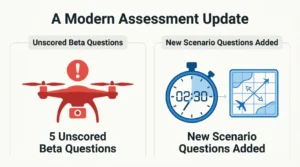
What the New Scenario Items Look Like:
- Weather & Chart Fusion: You will be given a specific METAR weather string and a sectional chart cutout, then asked to calculate the legal cloud clearance ceiling over a specific tower.
- Multi-Airspace Intersections: Questions now describe a complex flight path crossing through overlapping Class D and Class E airspaces, forcing you to determine exactly when Air Traffic Control (ATC) permission is required.
- Emergency Operations: Real-time situational questions require you to choose the exact legal action to take if a lithium-polymer battery catches fire inside a dense urban grid.
The Costly Punishment: 2026 FAA Retake Fees and Waiting Rules
Failing the Part 107 exam causes a costly roadblock for your business operations. The FAA manages its testing infrastructure through private PSI examination centers, and they do not grant financial leniency for failed attempts.
Every single testing slot you reserve requires a complete forfeiture of your initial financial investment if you fail to hit the 70% passing line.
The Financial and Time Penalties:
- The $175 Flat Fee: There are no discounted retake vouchers available for students or commercial businesses; every attempt costs $175 out of pocket.
- The 14-Day Lockout Rule: If your score report drops below 70%, the FAA platform locks your profile for exactly 14 calendar days to force a study window.
- The Recertification Standard: Remember that once you pass, your license does not expire, but you must complete a free online safety training module every 24 months to maintain currency.
How to Beat the New 2026 Drone Exam Structure
Safeguarding your $175 investment and passing the Part 107 test on your first attempt requires updating your study routines to match the current testing reality.
Do not simply memorize old flashcards; train your brain to read aviation maps under high pressure.
Actionable Study Tactics:
- Master the Knowledge Testing Supplement: Download the official FAA CT-8080-2H booklet. Spend 80% of your study time learning how to read the complex legends, military training routes, and radio frequencies.
- Use the Process of Elimination on Math: Airspace elevation questions always feature three choices. One choice is always a ground-level trap. Eliminate it immediately to give yourself a 50/50 odds profile.
- Prioritize Pacing: If you encounter a massive scenario question that takes more than two minutes to solve, flag it in the software and move on. Secure the easy vocabulary points first.
Frequently Asked Questions (FAQ)
Do the 5 new extra questions count toward my final score?
No. The 5 extra items are completely experimental and do not affect your final score. However, because they are mixed randomly into the test, you must answer all 65 questions carefully.
What is the minimum age to take the FAA Part 107 exam?
You must be at least 16 years old to sit for the official commercial drone pilot exam at an approved PSI testing center.
How long does it take to receive the physical drone license card?
After passing, you will receive a temporary digital certificate within 48 hours. The physical plastic Remote Pilot Certificate card is mailed to your home address by the FAA within 4 to 8 weeks.
Can I bring my own magnifying glass for the sectional charts?
Yes. PSI testing centers explicitly allow candidates to bring a standard, non-electronic magnifying glass to assist in reading the tiny text on aviation sectional maps.