
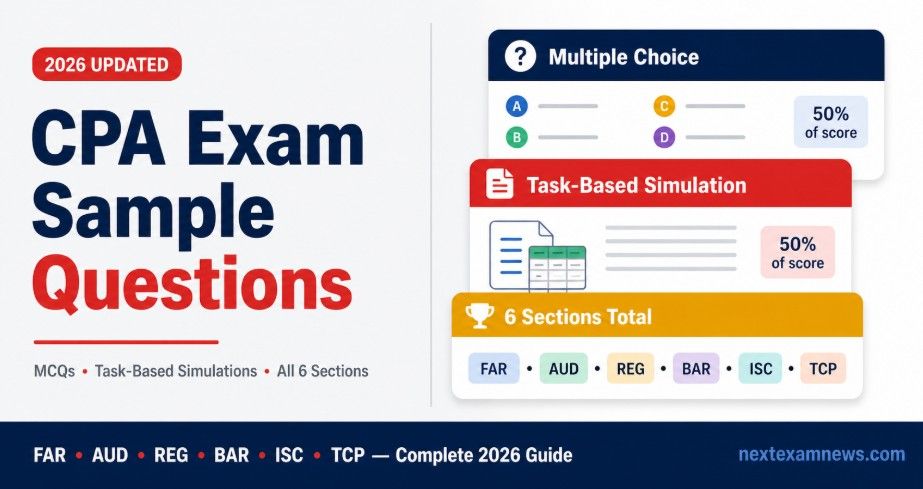
The CPA Exam has two question types — Multiple Choice Questions (MCQs) and Task-Based Simulations (TBS). Each counts for 50% of your score. The exam has 6 sections total: 3 Core sections (FAR, AUD, REG) that every candidate must pass, and 3 Discipline sections (BAR, ISC, TCP) where you pick one. Free official sample questions are available directly from the AICPA at aicpa-cima.com.
If you are preparing for the CPA Exam in 2026, practicing with sample questions is one of the most important things you can do before test day.
But before you start practicing, you need to understand what you are actually practicing for. The CPA Exam has a specific structure, two distinct question types, and real differences between sections that affect how you should prepare.
This guide breaks all of it down — the question formats, what each section tests, where the pass rates stand, and exactly where to find free official sample questions from the AICPA.
How the 2026 CPA Exam Is Structured
The CPA Exam under the CPA Evolution model has six sections divided into two groups.
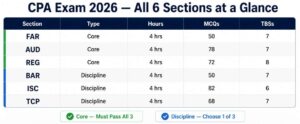
The three Core sections — Financial Accounting and Reporting (FAR), Auditing and Attestation (AUD), and Regulation (REG) — are mandatory. Every candidate must pass all three.
The three Discipline sections — Business Analysis and Reporting (BAR), Information Systems and Controls (ISC), and Tax Compliance and Planning (TCP) — are elective. You choose one and pass it. Your CPA license does not show which discipline you chose, so the choice comes down to your career goals and strengths.
Each section is four hours long. To pass, you need a scaled score of 75 or higher on each section. This is not a raw percentage — it is a weighted combination of your MCQ and TBS performance, adjusted for question difficulty.
Here is a quick reference for all six sections:
| Section | Type | Hours | MCQs | TBSs |
|---|---|---|---|---|
| FAR — Financial Accounting & Reporting | Core | 4 hrs | 50 | 7 |
| AUD — Auditing & Attestation | Core | 4 hrs | 78 | 7 |
| REG — Regulation | Core | 4 hrs | 72 | 8 |
| BAR — Business Analysis & Reporting | Discipline | 4 hrs | 50 | 7 |
| ISC — Information Systems & Controls | Discipline | 4 hrs | 82 | 6 |
| TCP — Tax Compliance & Planning | Discipline | 4 hrs | 68 | 7 |
Source: AICPA CPA Exam Blueprints 2026
The Two Question Types — What to Expect
Every section of the CPA Exam uses the same two question formats. Understanding both before you sit down to practice makes a real difference.
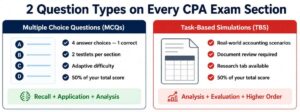
Multiple Choice Questions (MCQs) — 50% of Your Score
MCQs are the more familiar format. You get a question or scenario and choose the best answer from four options.
What makes CPA MCQs different from a typical multiple-choice test is the skill level they test. The AICPA uses three types of MCQs: Recall questions that test your memory of specific rules or facts, Interpretation questions that require you to determine what the AICPA is looking for given the scenario, and Problem-solving questions where you pick the best solution to a presented accounting problem.
The exam delivers MCQs in two testlets. The second testlet adapts based on your performance on the first — if you do well on testlet one, testlet two will be harder. This is normal and actually a good sign. Do not panic if the second batch feels noticeably more difficult.
One important detail: the AICPA includes pretest questions in every section. These are questions being tested for future use — they do not count toward your score. You cannot tell which questions are pretest questions, so treat every question as if it counts.
Task-Based Simulations (TBS) — 50% of Your Score
TBS questions are where many candidates struggle — not because the content is harder, but because the format is unfamiliar.
A TBS presents a real-world accounting scenario. You might be reviewing financial statements, filling in a tax form, or analyzing an audit situation. The task asks you to apply your knowledge to complete a specific professional task rather than just pick an answer.
Most TBS questions include a research tab where you can access the authoritative literature — the FASB Codification for FAR, the IRC for REG, or auditing standards for AUD. Knowing how to use these resources efficiently during the exam is a skill worth practicing separately.
TBS questions count for exactly half your score on every section. Candidates who underestimate them during preparation often find themselves surprised on exam day.
CPA Exam Pass Rates by Section — 2026
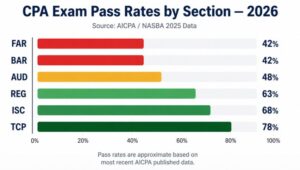
Understanding the pass rates tells you a lot about where to focus your preparation energy.
The CPA exam has approximately a 50% overall pass rate. Among the Core sections, FAR has the lowest pass rate at around 42% and is widely considered the hardest. AUD sits at approximately 48%, and REG is more approachable at around 63%. Among the Discipline sections, BAR matches FAR at approximately 42%, ISC is around 68%, and TCP is the highest at approximately 78%.
A few things these numbers tell you:
FAR and BAR are the toughest sections on the exam. FAR covers the widest range of content — financial accounting, governmental accounting, not-for-profit accounting, and more. If you are planning your exam order, most experienced CPA candidates recommend tackling FAR first while you have the most time and energy available.
TCP has the highest pass rate, but that does not necessarily mean it is easy — it means the candidates who choose it tend to have a strong tax background going in. Choose your discipline based on your background and career path, not the pass rate.
Important 2026 Update — Tax Law Change Affects REG and TCP
If you are sitting for REG or TCP in 2026, pay attention to this.
AICPA’s 2026 blueprint materials include a dedicated update for the One Big Beautiful Bill Act (OBBBA). Provisions with 2024 and 2025 effective dates become eligible for testing on REG and TCP starting July 1, 2026. If you sit for REG or TCP before that date, the exam tests pre-OBBBA law.
This means the tax law tested on REG and TCP changes partway through 2026. If your exam is scheduled for late summer or fall 2026, make sure your study materials are updated to reflect the OBBBA changes.
Where to Find Free Official CPA Sample Questions
The best place to practice is with official AICPA sample questions — and they are free.
The AICPA provides a free CPA sample test that includes questions from all six sections: AUD, FAR, REG, ISC, BAR, and TCP. You have up to two hours to complete it. The sample test is designed to operate in multiple browsers and replicates the exam experience, though it may not operate exactly as the CPA Exam Driver at the test center. You will be able to see the correct answers for each item.
The sample test is not scored and does not predict your readiness — but it is genuinely useful for getting comfortable with the exam interface before test day.
Access the free AICPA sample test at: aicpa-cima.com → Resources → CPA Exam → Sample Tests
Beyond the official sample test, the AICPA also offers paid study aids through their store — full question banks organized by section and topic. These are built on the actual exam blueprint and are worth the investment if you want the closest thing to real exam questions available.
How to Use Sample Questions Effectively
Practicing with sample questions only helps if you are doing it the right way. Here is what actually works:
Review every wrong answer — and every right one. On the CPA Exam, understanding why an answer is correct matters as much as knowing the answer itself. The AICPA tests your reasoning, not just your memory.
Time yourself from the start. Each section gives you four hours for your MCQs and TBSs combined. That works out to roughly two to three minutes per MCQ and fifteen to twenty minutes per TBS. Practicing without a timer gives you a false sense of readiness.
Practice the research function for TBS questions. The AICPA authoritative literature database is available during TBS questions. Most candidates who struggle with TBS questions have not practiced navigating it efficiently. The AICPA sample test lets you use the research tab — use it every time you practice.
Do not skip sections you feel confident about. The CPA Exam regularly tests familiar topics in unfamiliar ways. Something you know well in theory can still trip you up in a TBS format if you have not seen it presented that way before.
Which Section Should You Take First?
There is no single right answer, but there is a common approach that works for most candidates.
A common strategy is to take your discipline right after its related core section while the material is fresh. Many candidates start with FAR because it covers foundational concepts. Sample sequences: If choosing BAR — FAR → BAR → AUD → REG. If choosing ISC — FAR → AUD → ISC → REG. If choosing TCP — FAR → AUD → REG → TCP.
The most important rule is this: all four sections must be passed within a 30-month rolling window from your first passing score , though some jurisdictions allow longer. Check your state board for the exact window that applies to you.
Frequently Asked Questions
How many questions are on the CPA Exam?
It depends on which section and discipline you choose. Core sections range from 50 MCQs (FAR) to 78 MCQs (AUD), plus 7 to 8 TBS each. Discipline sections range from 50 MCQs (BAR) to 82 MCQs (ISC), plus 6 to 7 TBS each.
Are there free CPA Exam practice questions available?
Yes. The AICPA offers a free official sample test covering all six sections at aicpa-cima.com. It includes real exam-style questions with answer keys and simulates the actual exam interface.
What is the passing score for the CPA Exam?
You need a scaled score of 75 on a 0 to 99 scale for each section. This is not a raw percentage — it is a weighted, scaled score that accounts for question difficulty. You need to pass all four sections (three core plus one discipline) within the allowed timeframe.
Are CPA Exam questions multiple choice only?
No. The CPA Exam has two types — Multiple Choice Questions (MCQs) and Task-Based Simulations (TBS). Each type counts for 50% of your score on every section. TBS questions are practical, scenario-based tasks that require higher-order thinking and often involve the authoritative research database.
Which CPA Exam section is the hardest?
FAR and BAR both have the lowest pass rates at approximately 42%. FAR covers the broadest content range and is consistently rated as the most challenging by candidates. Most prep strategies recommend taking FAR first while your study momentum is at its peak.
How long do I have to pass all CPA Exam sections?
Most jurisdictions follow the NASBA recommendation of a 30-month rolling window from your first passing score. Some states allow longer. Check directly with your state board of accountancy for the exact rule in your jurisdiction.
Are there pretest questions on the CPA Exam?
Yes. The AICPA includes pretest questions in every section to evaluate them for future use. These questions do not count toward your score. You cannot identify which questions are pretest questions during the exam, so treat every question as if it counts.
Can I use the internet or reference materials during the CPA Exam?
No external resources. However, TBS questions include an authoritative literature research tab — FASB Codification for FAR, the Internal Revenue Code for REG, and auditing standards for AUD. Knowing how to navigate these databases efficiently is part of your preparation.
Bottom Line
The CPA Exam rewards candidates who understand the format before they start studying the content.
Knowing that TBS questions carry equal weight to MCQs — and that the exam adapts based on your first testlet performance — changes how you prepare. Knowing that FAR has the lowest pass rate tells you where to spend the most study time. And knowing that free official sample questions exist on the AICPA website means there is no excuse for going into test day without seeing what the actual exam interface looks like.
Start with the official free sample test. Practice both question types. Time yourself from day one. And check your state board for any jurisdiction-specific rules before you register.
Official Resources:
- AICPA Free CPA Sample Test: aicpa-cima.com — CPA Sample Tests
- AICPA CPA Exam Blueprints 2026: aicpa-cima.com — Exam Blueprints
- NASBA CPA Exam Information: nasba.org — CPA Exam