
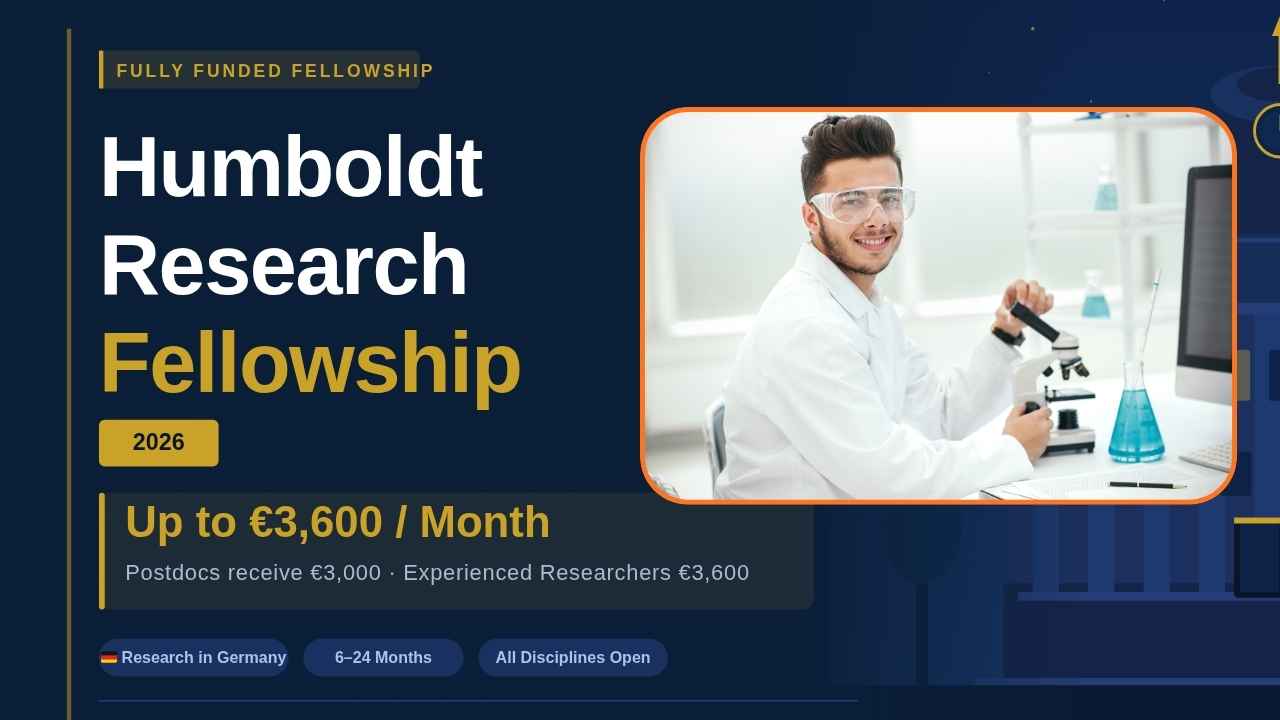
The Humboldt Research Fellowship is one of the most prestigious and generous international research fellowships in the world — offering postdoctoral researchers a monthly stipend of €3,000 and experienced researchers €3,600 to conduct independent research at a German institution of their choice for up to 24 months. The next application call opens on July 15, 2026.
If you hold a PhD and have been looking for a fully funded opportunity to advance your research career in Germany, the Alexander von Humboldt Foundation’s flagship fellowship program may be the most valuable application you make this year.
This guide covers everything — who qualifies, exactly how much you receive, what the selection process looks like, and the specific steps that separate successful applicants from the 75 to 80 percent who are rejected each year.
What Is the Humboldt Research Fellowship?
The Humboldt Research Fellowship is administered by the Alexander von Humboldt Foundation, a German government-funded organization established to promote international academic exchange and scientific collaboration.
The fellowship supports highly qualified postdoctoral and experienced researchers from around the world in conducting long-term research in Germany, in collaboration with a host at a German research institution. The program aims to promote international academic exchange, strengthen global research networks, and advance scientific and scholarly excellence across disciplines.
Approximately 700 Humboldt Research Fellowships are awarded annually across all disciplines.
This is not a scholarship for students. It is a competitive, merit-based research fellowship for scholars who have already completed their doctorate and are building an independent academic career.
The fellowship is similar to the Fulbright Fellowship in the United States and was created by the German government to foster collaborations between German researchers and researchers located outside Germany.
Also Read: Top 50 Universities in USA for MS in Cybersecurity (2026)
Two Types of Humboldt Research Fellowship — Which One Are You?
The Humboldt Foundation offers two distinct fellowship categories depending on where you are in your academic career. Applying to the wrong category is one of the most common avoidable mistakes.
Postdoctoral Researcher Fellowship
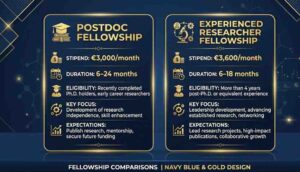
Fellowships for postdoctoral researchers are awarded for 6 to 24 months.
This category is designed for early-career researchers who completed their doctorate within the last four years. Eligible applicants must hold a doctorate or comparable academic degree completed less than four years prior to the date of application.
Monthly stipend: €3,000
Experienced Researcher Fellowship
The Humboldt Research Fellowship for experienced researchers enables highly qualified scientists and scholars from abroad who completed their doctorates less than twelve years ago to spend extended periods of research — 6 to 18 months, which may be divided into a maximum of three blocks — in Germany. Candidates are expected to have their own clearly defined research profile, meaning they should usually be working at least at the level of Assistant Professor or Junior Research Group Leader.
Monthly stipend: €3,600
Complete Benefits Package — Exactly What You Receive
The fellowship is fully funded and goes well beyond the monthly stipend. Here is the complete financial support package:
| Benefit | Amount / Details |
|---|---|
| Monthly stipend (Postdoc) | €3,000 per month |
| Monthly stipend (Experienced) | €3,600 per month |
| Fellowship duration (Postdoc) | 6 to 24 months |
| Fellowship duration (Experienced) | 6 to 18 months (up to 3 blocks) |
| Round-trip travel grant | Included for fellow |
| Health and liability insurance | Subsidized by Foundation |
| Family allowance | Available for accompanying spouse/partner |
| Childcare allowance | Additional flat-rate for single parents |
| Research cost allowance (host) | €800/month (sciences) / €500/month (humanities) |
| Alumni benefits | Lifelong network access, return fellowships |
| German language courses | Funded by Foundation |
| Maternity/paternity extensions | Available upon request |
Additional financial support is provided for accompanying family members and items like travel expenses, along with comprehensive alumni sponsorship once the research stay has concluded, such as a return fellowship or further stays in Germany.
Who Is Eligible — The Full Requirements
Meeting the eligibility requirements is the first gate. Many applications are rejected at the formal admissibility stage before even reaching peer review.
Academic Qualification
Candidates must hold a doctoral degree or equivalent academic qualification, demonstrate a strong academic record and an independent research profile, and have a well-defined research project to be carried out in collaboration with a host at a German university or research institution.
In fields where doctorates are uncommon, candidates may apply up to 16 years after completing a master’s degree if they have an appropriate research publication record.
Nationality Requirements
You must not be a German national. If you are a German national, or if you obtained your university entrance qualification and university degree, or your university degree and your doctorate, in Germany, you can apply if you have lived and worked abroad for more than ten years and intend to continue doing so long-term.
The fellowship is open to individuals from all over the world except Brazil. Brazilian researchers have a dedicated CAPES-Humboldt Fellowship track.
Residency Requirement
For your application to be successful, you may not have lived in Germany for longer than a total of 90 days within the 18-month period prior to submitting your application.
Host Requirement
Applicants must secure a written hosting agreement from a qualified academic host in Germany before applying. This is not optional — without a confirmed host, your application cannot be submitted.
Previous Recipients
Previous recipients of Humboldt Foundation research fellowships are not eligible to apply.
Also Read: How to Get Canva Pro Free for Students Officially in 2026
The Selection Process — How Decisions Are Made
Understanding how the Humboldt Foundation selects fellows gives you a significant advantage when structuring your application.
Applications are accepted on a rolling basis, with selection committees meeting three times per year — in March, July, and November. Completed applications, including all required documents, must be submitted well in advance of the intended selection round. Applications are typically processed within four to eight months. Decisions cannot be appealed, however applicants may reapply if they substantially improve key elements of their application. Applications that are unanimously rejected are subject to a minimum 18-month waiting period before reapplication.
Approval Rate
Looking ahead to upcoming meetings of the selection committee, the Foundation expects that 20 to 25 percent of the applications received will be approved.
That means three out of every four applications are rejected. This is a competitive program — and the quality of your application materials determines everything.
The Three Stages
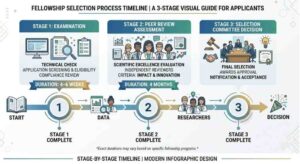
The selection process comprises three steps — Examination, Assessment, and Selection. During Examination, the application undergoes a formal admissibility check, which takes 4 to 6 weeks. During Assessment, two independent experts review the application and prepare reports. Assessment typically takes approximately 4 months. In the final Selection stage, deserving applications are accepted and results are usually released in February/March, June/July, or October/November.
Each call accepts a maximum of 800 applications. The current call has already reached capacity — the next call will open on July 15, 2026.
What Documents You Need — Complete Checklist
The required documents for a Humboldt Research Fellowship application include: an updated CV of no more than two pages, a research outline of no more than five pages, a complete list of publications, a list of selected key publications, the key publications themselves, two expert reviews, the doctoral certificate, a German language certificate if applicable, and the host’s statement and confirmation of research facilities.
Additionally, where required: publisher’s letters of acceptance and acknowledgments of receipt, as well as summaries or translations of key publications not available in English.
Critical point on expert reviews: Expert reviews must come from the doctoral supervisor and another academic qualified to give well-founded comments on the applicant’s qualifications — preferably including reviewers not working at the applicant’s institute.
Getting a strong review from someone outside your immediate institution signals independent validation of your work — something the committee weighs heavily.
How to Find a Host in Germany — The Step That Trips Most Applicants
The host requirement is where most eligible researchers get stuck. You cannot apply without a confirmed academic host at a German research institution — and finding the right one takes time and a strategic approach.
Step 1 — Identify Relevant Research Groups
Search the German Research Foundation (DFG) database and individual university faculty pages to find professors whose work aligns closely with your research proposal. The Humboldt Foundation’s own alumni network — the Humboldtians database — is also a valuable resource for identifying potential hosts who already understand the fellowship process.
Step 2 — Make Contact Early
Reach out to potential hosts at least 4 to 6 months before you plan to apply. A cold email works — but it needs to be specific. Reference their recent publications, explain precisely how your proposed research connects to their work, and ask clearly whether they would be willing to host a Humboldt Research Fellowship applicant.
Step 3 — Agree on the Research Outline Together
Applicants must agree on the details of the research outline, including information on the intended duration of the fellowship, with the intended host before applying. This is a collaborative document — not something you write and then ask them to sign off on.
Step 4 — Get the Host Statement
Your host must provide a detailed expert statement supporting your research project and written confirmation that research facilities will be available. The host institution plays a crucial role in facilitating the fellow’s research activities.
How to Write a Winning Application — What Reviewers Look For
With a 20 to 25 percent approval rate, the difference between selected and rejected applications comes down to a small number of specific factors.
Research Outline Quality
The five-page research outline is the most important document in your application. Reviewers are looking for a clearly defined, original research question — not a broad topic area. Your outline should explain what you will do, why it can only be done at your chosen German institution, and what the expected outcomes are.
Vague language like “I plan to investigate the relationship between X and Y” will not stand out. Specific, falsifiable hypotheses with a clear methodology will.
Publication Record
Selection for the Humboldt Research Fellowship is based entirely on academic excellence and research potential. Applications undergo independent peer review by international experts. Reviewers assess academic performance, mobility, research productivity, and the originality and quality of published research work.
For postdoctoral applicants, reviewers look at the quality and impact of publications relative to your career stage — not the absolute number. A single first-author paper in a top journal can outweigh several minor contributions.
The Host Match
Reviewers pay close attention to the fit between your research proposal and your host’s expertise. A strong host who is well-known in the field and who writes an enthusiastic, specific support letter significantly improves your chances. A generic letter from a prestigious institution is less valuable than a detailed, personalized statement from a well-matched host.
Language Skills
Necessary language skills vary by field — humanities, social sciences, and medicine require German or good knowledge of English; natural sciences and engineering require good knowledge of German or English.
Application Timeline — Next Steps for 2026
| Milestone | Date |
|---|---|
| Current call closed (capacity reached) | April 2026 |
| Next call opens | July 15, 2026 |
| Selection committee meeting | November 2026 |
| Results notification | October/November 2026 |
| Fellowship start window | 2 to 12 months after approval |
Given that applications are processed within four to eight months and the next call opens July 15, 2026 — researchers who want to present at the November 2026 committee should plan to submit in August or September 2026 at the latest.
Start identifying your host now. That process alone typically takes two to three months.
Which Fields Are Eligible?
The program supports researchers from all disciplines, fostering an interdisciplinary and globally connected research community. This flexibility allows scholars to pursue innovative research ideas and develop global collaborations.
Every academic discipline is eligible — from molecular biology and engineering to history, linguistics, economics, and law. The Humboldt Foundation does not favor any single field.
Frequently Asked Questions
Q: When does the next Humboldt Research Fellowship call open in 2026?
The next call will open on July 15, 2026. The current call has already reached its maximum number of applications and is closed.
Q: How much is the Humboldt Research Fellowship stipend in 2026?
Postdoctoral researchers receive a monthly fellowship of €3,000 for doctorates completed within the last four years. Experienced researchers receive €3,600 monthly for doctorates completed within the last twelve years.
Q: How long does the Humboldt Research Fellowship last?
Postdoctoral fellowships run for 6 to 24 months. Experienced researcher fellowships run for 6 to 18 months and can be divided into up to three separate stays within a three-year window.
Q: What is the acceptance rate for the Humboldt Research Fellowship?
The Foundation expects that 20 to 25 percent of applications received will be approved at each selection committee meeting.
Q: Can American or British researchers apply for the Humboldt Fellowship?
Yes. The fellowship is open to researchers of any nationality — US, UK, Canadian, Australian, and all other non-German citizens are welcome to apply, provided they meet the eligibility requirements.
Q: Do I need to speak German to apply?
Not necessarily. Natural sciences and engineering fields require good knowledge of German or English. Humanities, social sciences, and medicine require German or good knowledge of English. Most STEM applicants can apply with English proficiency alone.
Q: Can I apply to multiple Humboldt programs at the same time?
It is not possible to apply to several fellowship programs concurrently. Should you be rejected by any of them, you may apply to any other program as long as you fulfill the formal requirements.
Q: What happens if I am rejected?
Decisions cannot be appealed. However, applicants may reapply if they substantially improve key elements of their application. Applications that are unanimously rejected are subject to a minimum 18-month waiting period before reapplication. You can request feedback on why your application was not selected.
Q: Is family support available during the fellowship?
Yes. Family members accompanying the fellow for a minimum of three months may qualify for family allowances and insurance subsidies. Single parents can apply for additional flat-rate allowances. Fellowship extensions may be granted for maternity periods or childcare responsibilities.
Q: Can I do research outside Germany during my fellowship period?
Under certain circumstances, research fellows may conduct research outside Germany during the sponsorship period if this is necessary to successfully carry out the research project — for example, for field research, archive visits, or experiments at specific facilities — or for personal or organizational reasons such as family obligations or health issues.
The Bottom Line
The Humboldt Research Fellowship is one of the best-funded, most flexible, and most prestigious research fellowships available to international academics in 2026.
With up to €3,600 per month, round-trip travel, health insurance, family support, and a lifelong alumni network, it is a genuinely transformative opportunity — not just financially, but in terms of the international collaborations and career momentum it creates.
The 20 to 25 percent acceptance rate is demanding — but it is not beyond reach for a well-prepared applicant with a strong publication record, a specific and original research proposal, and the right host in Germany.
The next call opens July 15, 2026. Use the months between now and then to identify your host, develop your research outline, and request your expert reviews. That preparation time is what separates competitive applications from the ones that never make it past the admissibility check.
Official Resources:
- Apply online: humboldt-foundation.de/en/apply/sponsorship-programmes/humboldt-research-fellowship
- Contact the Foundation: info@avh.de
- Research in Germany database: research-in-germany.org
- DFG Research Portal: gepris.dfg.de
Disclaimer: This article is for informational purposes only. Fellowship amounts, dates, and eligibility criteria are subject to change. Always verify current details directly with the Alexander von Humboldt Foundation at humboldt-foundation.de before applying.