
| The best MS in Cybersecurity program in the USA in 2026 is offered by Georgia Institute of Technology, with total tuition under $12,000 — making it the best value graduate cybersecurity degree in the country. Carnegie Mellon University ranks #2 overall with triple NSA/DHS CAE designation and median graduate salaries of $147,000 after one year. UC Berkeley ranks #3, with graduates earning over $214,000 in median four-year earnings. |
Cybersecurity is one of the fastest-growing career fields in the United States. The U.S. Bureau of Labor Statistics projects 33% employment growth for information security analysts from 2024 to 2034, with approximately 17,300 new openings annually. With over 470,000 open cybersecurity positions in the US right now and a chronic talent shortage, an MS in Cybersecurity is one of the smartest investments a student can make in 2026.
This guide covers the top 50 universities for an MS in Cybersecurity in the USA — with real tuition costs, NSA/DHS Center of Academic Excellence (CAE) designations, GRE requirements, and graduate salary data. Whether you are a recent undergraduate looking for your next step or a working professional considering a career switch, this list gives you everything you need to make the right decision.
Why an MS in Cybersecurity in the USA Is Worth It in 2026
The numbers make a compelling case on their own.
The Bureau of Labor Statistics reports the median salary for Information Security Analysts at $124,910. Cybersecurity salaries in 2026 range from $55,000 for entry-level technicians to $420,000 or more for CISOs at large enterprises. The national average sits at $135,969.
The job market is equally impressive. CyberSeek tracks over 470,000 cybersecurity job openings in the United States alone, with the supply-demand ratio confirming chronic undersupply. 5.5 million cybersecurity professionals are actively employed worldwide — a record high — yet the total workforce needed is 10.2 million, leaving a gap of 4.8 million unfilled positions.
For international students, the STEM designation that most cybersecurity MS programs carry means up to three years of Optional Practical Training (OPT) after graduation — giving graduates extended time to work in the US before needing visa sponsorship.
53% of employers are increasing starting pay for cybersecurity talent in 2026. The demand for skilled practitioners continues outpacing supply, driving compensation upward across all experience levels.
Simply put — a cybersecurity MS from a strong US university is one of the highest-ROI graduate degrees available today.
What Is a CAE Designation and Why It Matters
Before diving into the rankings, every prospective student should understand what a CAE designation means — because it significantly affects the quality and recognition of the program.
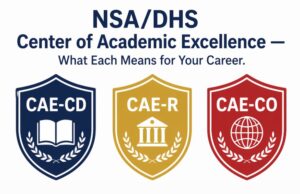
CAE stands for Center of Academic Excellence. It is awarded by the National Security Agency (NSA) and the Department of Homeland Security (DHS) to universities that meet rigorous cybersecurity education standards.
There are three types of CAE designations:
- CAE-CD — Cyber Defense. The most common designation, focused on defending systems.
- CAE-R — Research. Awarded to universities conducting elite cybersecurity research.
- CAE-CO — Cyber Operations. The rarest designation, focused on offensive security techniques.
CMU is one of just 11 colleges and universities designated by the National Security Agency and Department of Homeland Security as a Center of Academic Excellence in Cyber Defense, Cyber Operations, and Research simultaneously. This triple designation is extremely rare and highly valued by employers, particularly in government and defense contracting.
How We Ranked These 50 Universities
This list evaluates programs based on five key factors:
Program Reputation & Accreditation — CAE designations, research output, and US News computer science rankings form the baseline.
Graduate Career Outcomes — Median salaries, employment rates, and employer partnerships were weighted heavily. A degree that pays off matters more than prestige alone.
Tuition and ROI — Total program cost versus graduate salary outcomes determines the actual return on investment.
Curriculum Relevance — Programs that incorporate AI security, cloud security, zero-trust architecture, and modern threats scored higher than those with outdated coursework.
Accessibility — Availability of online, hybrid, and on-campus options. GRE requirements and GPA minimums affect real-world accessibility.
Top 10 Elite MS Cybersecurity Programs in the USA (2026)
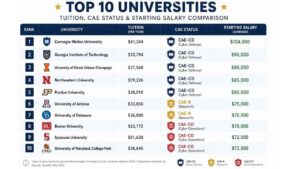
#1 — Georgia Institute of Technology — Atlanta, GA
Total Tuition: ~$10,720 (online) | ~$20,790 (on-campus, in-state)
CAE Designation: None (but top employer recognition)
GRE Required: No
Format: Online & On-Campus
Median Graduate Salary: $130,000+
Georgia Tech holds the top spot in 2026 for one reason most rankings miss — value. For less than $12,000 for online learning, you get a master’s from a top-rated public university. Georgia Tech earns the #1 spot for its blend of elite affordability and genuinely strong academic credentials.
The online MS program is specifically designed for working professionals and can be completed in 2 to 3 years. Three specialization tracks — Information Security, Policy, and Cyber-Physical Systems — give students flexibility to align the degree with their career goals.
Employers in government, defense contracting, and top tech companies consistently recruit Georgia Tech cybersecurity graduates. The name carries significant weight in every sector.
#2 — Carnegie Mellon University — Pittsburgh, PA
Total Tuition: ~$75,750 (on-campus MS in Information Security)
CAE Designation: CAE-CD + CAE-CO + CAE-R (Triple Designated)
GRE Required: No
Format: On-Campus (MS in Information Security); Online (MSIT: Information Security & Assurance)
Median Graduate Salary: $147,000 after 1 year
Carnegie Mellon is the gold standard for cybersecurity education in the United States. Carnegie Mellon is one of a select few schools that has an elite overall reputation and a clear cybersecurity specialism. Triple CAE-designated, the median salary for 2024 graduates after 1 year is $147,000.
The Software Engineering Institute at CMU is a research and development center funded by the Department of Defense. This gives CMU students unparalleled access to cutting-edge research and federal agency partnerships.
The on-campus MSIS is highly technical and intensive. The online MSIT option requires 3 or more years of professional experience and is better suited for mid-career professionals.
#3 — University of California, Berkeley — Berkeley, CA
Total Tuition: ~$30,000–$35,000 (online MICS program)
CAE Designation: None
GRE Required: No
Format: Online (MICS program)
Median 4-Year Graduate Earnings: $214,000+
UC Berkeley currently has no CAE designations, but it was a top achiever for median 4-year earnings in 2026 at $214,000 or more.
Berkeley’s Master of Information and Cybersecurity (MICS) program is available fully online and covers economic, legal, behavioral, and ethical dimensions of cybersecurity alongside core technical skills. Its strength is name recognition — a Berkeley degree opens doors in Silicon Valley and at top tech companies that few other schools can match.
#4 — Johns Hopkins University — Baltimore, MD
Total Tuition: ~$54,550 (online)
CAE Designation: CAE-R
GRE Required: No
Format: Online & On-Campus
Notable Feature: Courses on space systems cybersecurity and cyber AI
Johns Hopkins combines Ivy League prestige with genuine cybersecurity specialization. Johns Hopkins receives recognition in rankings for its courses on space systems cybersecurity, assured autonomy — securing driverless vehicles — and cyber AI.
Its proximity to Washington DC, the NSA headquarters, and major defense contractors makes it a top choice for students targeting government and national security careers. Its CAE-R designation signals elite research output.
#5 — New York University — New York, NY
Total Tuition: ~$33,080 (online)
CAE Designation: CAE-CD + CAE-R
GRE Required: No
Format: Online & On-Campus
Notable Feature: Flexible curriculum — 4 core + 6 elective courses
NYU is a standout for accessibility. Whereas Berkeley only has an online option and Carnegie Mellon’s MSIS can only be completed on campus, NYU boasts top-level accessibility. Elective options include AI governance, applied blockchain, and deep learning.
NYU’s location in New York City provides exceptional networking opportunities with Wall Street firms, media companies, and tech startups — all major cybersecurity employers.
#6 — Duke University — Durham, NC
Total Tuition: ~$60,000–$70,000
CAE Designation: None
GRE Required: Optional
Format: On-Campus
Notable Feature: Internship built into the program
Duke stands out as one of the few cybersecurity master’s programs with an internship built in. Employers seem to like it — nearly 90% of graduates are in work or further education within 6 months.
Duke’s cybersecurity program is ideal for students who want real-world experience embedded in their degree — not as an afterthought.
#7 — University of Maryland — College Park, MD
Total Tuition: ~$22,837 (online, in-state)
CAE Designation: CAE-CD + CAE-R
GRE Required: No
Format: Online & On-Campus
Notable Feature: Direct access to NSA, CISA, and DoD agencies
University of Maryland’s College Park campus sits minutes from the NSA’s Fort Meade headquarters and feeds directly into federal cybersecurity careers. Its dual CAE designation and government pipeline make it the top choice for students targeting public sector work.
#8 — Mississippi State University — Starkville, MS
Total Tuition: ~$13,200 (campus)
CAE Designation: CAE-CD + CAE-CO + CAE-R (Triple Designated)
GRE Required: No Format: Online & On-Campus
Notable Feature: One of only 11 schools with triple CAE designation
Mississippi State is one of a small number of institutions to be triple-designated. It has consequently outperformed in rankings in relation to its general reputation as a university compared to Ivy League and other elite institutions.
For students who prioritize program quality over school name — and want a triple CAE designation at a fraction of the cost of Carnegie Mellon — Mississippi State is an outstanding choice.
#9 — Auburn University — Auburn, AL
Total Tuition: ~$19,990 (on-campus)
CAE Designation: CAE-CD + CAE-CO + CAE-R (Triple Designated)
GRE Required: No
Format: Online, On-Campus, Hybrid
Notable Feature: One of only 11 triple CAE-designated schools nationally
Along with Mississippi State, Auburn is one of just 11 schools nationwide to hold all three CAE designations. The balance of research and practical skills can be seen in the content of this master’s course; the academic credentials are great for those targeting subsequent PhD-level education, while a capstone project will appeal to practitioners.
Auburn’s strong alumni network in government and defense sectors, combined with its triple designation, makes it underrated relative to its program quality.
#10 — George Washington University — Washington, DC
Total Tuition: ~$52,380 (online)
CAE Designation: CAE-R
GRE Required: No
Format: Online & On-Campus
Notable Feature: Focus on malware detection, penetration testing, digital forensics
GWU’s Washington DC location places it at the center of federal cybersecurity activity. GW is federally designated by the National Security Agency as a National Center of Excellence for Cyber Defense Research.
Two distinct MS programs — one technical and one policy-focused — allow students to choose a path aligned with their career direction.
#11 to #25 — Strong Programs With Excellent Value
| Rank | University | State | Tuition (Est.) | CAE | GRE |
|---|---|---|---|---|---|
| 11 | University of Delaware | DE | $32,070 | CAE-CD | No |
| 12 | Old Dominion University | VA | ~$20,000 | CAE-CD + CAE-CO + CAE-R | No |
| 13 | Kennesaw State University | GA | ~$9,270 | CAE-CD | No |
| 14 | West Virginia University | WV | ~$25,000 | CAE-R | No |
| 15 | George Mason University | VA | ~$28,875 | CAE-CD | No |
| 16 | University of Arizona | AZ | ~$23,400 | CAE-CD | No |
| 17 | Northeastern University | MA | ~$57,000 | CAE-CD | No |
| 18 | New Jersey Institute of Technology | NJ | ~$26,760 | CAE-CD + CAE-R | No |
| 19 | University of Houston | TX | ~$20,850 | CAE-CD | No |
| 20 | Illinois Institute of Technology | IL | ~$33,000 | CAE-CD | No |
| 21 | University of Texas at Dallas | TX | ~$24,825 | CAE-CD | No |
| 22 | Champlain College | VT | ~$17,700 | CAE-CD | No |
| 23 | University of Cincinnati | OH | ~$22,770 | CAE-CD | No |
| 24 | DePaul University | IL | ~$27,900 | CAE-CD | No |
| 25 | Nova Southeastern University | FL | ~$21,067 | CAE-CD | No |
#26 to #50 — Affordable & Accessible Programs
| Rank | University | State | Tuition (Est.) | CAE | Format |
|---|---|---|---|---|---|
| 26 | University of Wisconsin–Green Bay | WI | ~$16,500 | CAE-CD | Online |
| 27 | St. Mary’s University | TX | ~$13,200 | CAE-CD | Campus |
| 28 | Purdue University Global | IN | ~$15,780 | CAE-CD | Online |
| 29 | University of South Florida | FL | ~$16,368 | CAE-CD | Online |
| 30 | Dakota State University | SD | ~$10,470 | CAE-CD | Online |
| 31 | University of Alabama in Huntsville | AL | ~$20,400 | CAE-CD | Online |
| 32 | Rochester Institute of Technology | NY | ~$41,232 | CAE-CD | Campus |
| 33 | Cal Poly Pomona | CA | ~$15,652 | CAE-CD | Campus |
| 34 | Capitol Technology University | MD | ~$18,000 | CAE-CD | Online |
| 35 | Lewis University | IL | ~$17,153 | CAE-CD | Online |
| 36 | University of Detroit Mercy | MI | ~$17,850 | CAE-CD | Online |
| 37 | Towson University | MD | ~$22,935 | CAE-CD | Online |
| 38 | Regent University | VA | ~$19,836 | CAE-CD | Online |
| 39 | Bay Path University | MA | ~$23,550 | CAE-CD | Online |
| 40 | Utica University | NY | ~$20,790 | CAE-CD | Online |
| 41 | University of San Diego | CA | ~$39,000 | CAE-CD | Online |
| 42 | Hood College | MD | ~$26,400 | CAE-CD | Online |
| 43 | Bellevue University | NE | ~$15,900 | CAE-CD | Online |
| 44 | Webster University | MO | ~$17,700 | CAE-CD | Online |
| 45 | University at Albany (SUNY) | NY | ~$22,837 | CAE-CD + CAE-R | Online |
| 46 | Excelsior University | NY | ~$23,550 | CAE-CD | Online |
| 47 | Southern Utah University | UT | ~$12,750 | CAE-CD | Online |
| 48 | Wilmington University | DE | ~$11,850 | CAE-CD | Online |
| 49 | Thomas Edison State University | NJ | ~$9,270 | CAE-CD | Online |
| 50 | Augusta University | GA | ~$16,380 | CAE-CD | Online |
How to Choose the Right Program for You
With 277 MS in Cybersecurity programs in the US and 50 strong options on this list alone, narrowing your choice comes down to four personal factors.
Your Career Goal Determines Everything
If you want to work for the federal government, NSA, DHS, FBI, or major defense contractors — prioritize schools with CAE designations and proximity to Washington DC. University of Maryland, George Mason, George Washington, Johns Hopkins, and Old Dominion University all have proven federal pipelines.
If you want Silicon Valley or Big Tech — Berkeley and Carnegie Mellon will open those doors faster than any other programs. NYU works well for New York-based finance and media companies.
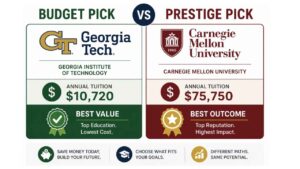
If you want flexibility and affordability as a working professional — Georgia Tech’s online program is the clear winner at under $12,000 total.
On-Campus vs Online vs Hybrid
Most programs in 2026 offer flexible delivery. NYU boasts top-level accessibility — you can attend on campus, online, or in a blended format — whereas Berkeley only has an online option and Carnegie Mellon’s MSIS can only be completed on campus.
Consider whether you can relocate, whether you need evening or weekend classes, and how quickly you want to complete the degree.
GRE Requirements
Good news for most applicants — the majority of programs on this list do not require the GRE in 2026. Always verify directly with the university before applying, as requirements can change.
Tuition vs Graduate Salary ROI
The median annual wage for information security analysts is approximately $124,910. The BLS projects employment for information security analysts to grow 29% from 2024 to 2034.
Even the most expensive programs on this list — Carnegie Mellon at $75,750 — can be recovered within one year given graduate salary outcomes. Calculate your personal ROI before choosing a program based on cost alone.
Admission Requirements — What You Need to Apply
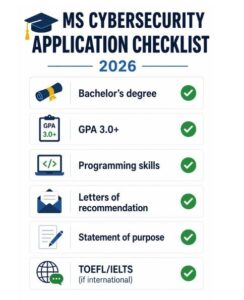
Most MS in Cybersecurity programs in the USA share similar baseline requirements.
Undergraduate Degree — A bachelor’s in computer science, information technology, electrical engineering, or a related STEM field is standard. Some programs — including Berkeley’s MICS — accept students from non-technical backgrounds with demonstrated quantitative skills.
GPA — Most programs require a minimum 3.0 GPA on a 4.0 scale. Some programs like Kennesaw State accept applicants with a 2.75 GPA, considered on a case-by-case basis.
Programming Background — Many technical programs expect proficiency in Python or Java. Carnegie Mellon specifically recommends completing a college-level, object-oriented programming course before applying to their online program.
Work Experience — Not required for most programs, but Carnegie Mellon’s online MSIT specifically requires 3 or more years of relevant professional experience.
English Proficiency — International students typically need TOEFL scores of 90+ or IELTS of 7.0+. Requirements vary by program.
Statement of Purpose and Letters of Recommendation — Nearly universally required. Strong SOPs should articulate specific career goals and how the program’s curriculum supports them.
Scholarships and Financial Aid for Cybersecurity MS Students
Cybersecurity is one of the few graduate fields with significant government-funded scholarship programs.
CyberCorps Scholarship for Service (SFS) — Funded by the National Science Foundation, this program pays full tuition plus a stipend in exchange for working in a federal government cybersecurity role after graduation. Students at CAE-designated schools are eligible to apply. The Georgia Tech program specifically notes it qualifies for CyberCorps SFS funding.
DoD Cyber Scholarship Program (CSA) — Available to students at select schools, including Carnegie Mellon and others. DoD CSA scholarships are available to CMU students. These scholarships are highly competitive but cover full tuition plus living expenses in exchange for post-graduation federal service.
SMART Scholarship — The Science, Mathematics, and Research for Transformation scholarship is available to US citizens pursuing STEM degrees who commit to working for the Department of Defense after graduation.
Institutional Aid — Many universities on this list offer merit-based assistantships, fellowships, and research funding. Qualified students with a 2.5 GPA and up may receive up to $20,000 in grants and scholarships at some institutions.
Always check directly with each university’s financial aid office and cybersecurity department for the most current scholarship offerings.
Career Outcomes — What Happens After You Graduate
The cybersecurity job market in 2026 is one of the most favorable for new graduates of any discipline.
The BLS projects employment for information security analysts to grow 29% from 2024 to 2034, far faster than the average growth rate for all occupations. Over that decade, an average of about 16,000 openings per year are expected.
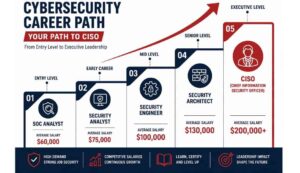
Entry-level roles available to MS graduates include Security Analyst ($85,000–$95,000), SOC Analyst ($65,000–$95,000), Penetration Tester ($93,000–$136,000), and Cloud Security Engineer ($108,000–$130,000).
With 5 to 10 years of experience, MS graduates commonly advance to Security Architect ($130,000–$175,000), Threat Intelligence Manager ($120,000–$160,000), or Chief Information Security Officer roles that can exceed $256,000 in median compensation.
Certifications deliver measurable pay boosts: Security+ adds 11%, CISSP adds 22%, and cloud security credentials add up to 25%.
The highest-paying metro areas for cybersecurity roles are San Jose ($175,520 average), San Francisco ($168,160), and Washington DC — all with strong connections to universities on this list.
 .
.
Frequently Asked Questions
Q: What is the best MS in Cybersecurity program in the USA in 2026?
The best overall program depends on your goals.
– For value, Georgia Tech at under $12,000 is unmatched.
– For prestige and federal career pipelines, Carnegie Mellon with triple CAE designation leads.
– For Silicon Valley and tech company careers, UC Berkeley is the top choice.
Q: Do I need a GRE score to apply for an MS in Cybersecurity in the USA?
Most programs on this list do not require the GRE in 2026, including Georgia Tech, Carnegie Mellon’s online program, NYU, Johns Hopkins, and most CAE-designated schools. Always confirm with the specific program before applying.
Q: How long does an MS in Cybersecurity take to complete?
Most full-time on-campus programs take 18 to 24 months. Online and part-time options range from 10 months at the fastest (Champlain College) to 3 years for working professionals at Georgia Tech.
Q: Is an MS in Cybersecurity worth it in 2026?
Yes — with a strong ROI in almost every case. Even Carnegie Mellon’s $75,750 program is recoverable within one year given $147,000 median starting salaries for graduates. Programs under $20,000 at CAE-designated schools offer exceptional returns.
Q: Can international students get an MS in Cybersecurity in the USA?
Yes. Most programs on this list accept international students. The STEM designation of these programs qualifies graduates for up to 3 years of OPT work authorization, making them financially practical. International students should verify English proficiency requirements and scholarship eligibility at each institution.
Q: What GPA is needed for an MS in Cybersecurity in the USA?
Most programs require a minimum 3.0 GPA. Some schools like Kennesaw State accept applicants with a 2.75 GPA. A lower GPA can sometimes be offset by strong work experience, certifications, or a compelling statement of purpose.
Q: Which universities have the NSA CAE triple designation?
As of 2026, only 11 universities hold all three CAE designations (CAE-CD, CAE-CO, and CAE-R) simultaneously. On this list, Carnegie Mellon, Mississippi State, and Auburn University are among those elite institutions.
Q: What cybersecurity certifications should I pursue alongside my MS?
Security+ adds 11% to salary, CISSP adds 22%, and cloud security credentials like AWS Security Specialty or CCSP add up to 25%. The OSCP certification correlates with the highest job offer salaries for technical roles.
Q: How much do cybersecurity MS graduates earn in the USA?
Entry-level graduates typically earn $85,000 to $110,000. Mid-career professionals with an MS earn $120,000 to $160,000. Senior specialists, architects, and CISOs earn $175,000 to $420,000 or more.
Q: What is the cheapest MS in Cybersecurity program in the USA?
Thomas Edison State University offers a CAE-CD designated MS program at approximately $9,270 total tuition. Georgia Tech’s online program comes in just above $10,720 but carries significantly more employer recognition and career value.
Conclusion
Cybersecurity is not just a career — it is one of the most essential and fastest-growing professional fields of the decade. The global cybersecurity workforce gap stands at 4.8 million unfilled positions, growing 19% year-over-year despite the workforce itself expanding.
An MS in Cybersecurity from one of these 50 universities positions you at the front of that demand. Whether you choose the affordability of Georgia Tech, the prestige of Carnegie Mellon, the Silicon Valley connections of Berkeley, or the federal pipeline of University of Maryland — each program on this list offers a credible, career-transforming path.
Start by identifying your career goals, then use the tuition, CAE designation, and salary data in this guide to find the program that fits your budget and ambitions.
The cybersecurity talent gap will not close itself. In 2026, the question is not whether a cybersecurity career is worth pursuing — it is which program gets you there fastest.
|
Check Out more Resources:
|
|
Disclaimer: Tuition figures are estimates based on 2025–2026 published rates and are subject to change. Always verify directly with each university’s official website before applying or making financial decisions. |