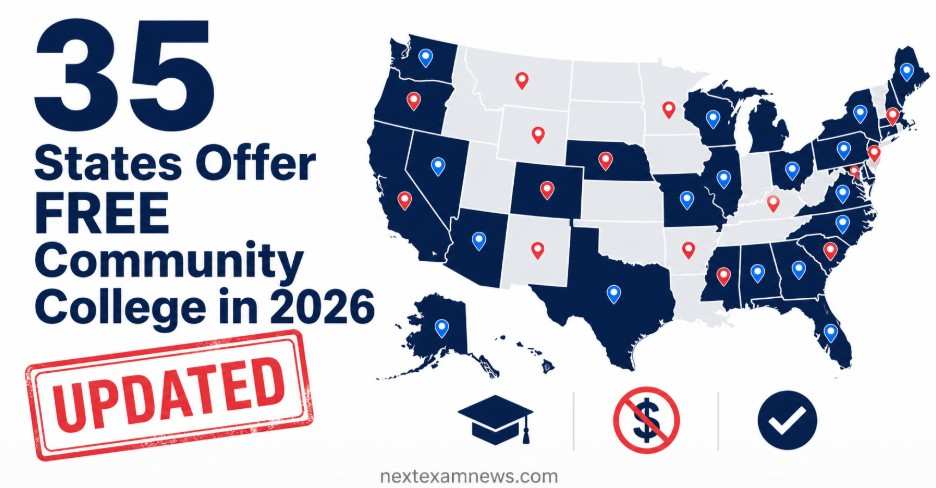
As of 2026, at least 35 states offer some form of free or tuition-reduced community college program. These are called “Promise Programs.” Most require you to be a state resident, complete the FAFSA, and maintain satisfactory academic progress. Coverage varies — some states pay everything, others just fill the gap after your Pell Grant.
If you’ve been putting off college because of the cost, this article is for you.
Community college has always been the more affordable path to higher education. But what most people don’t realize is that in 2026, you might not have to pay anything at all — depending on where you live.
Thirty-five states now run programs that make community college tuition free — or close to it — for qualifying students. These aren’t obscure loopholes or complicated scholarships. They are official state-funded programs, and millions of Americans are already using them.
Below is everything you need to know: which states are on the list, who qualifies, what’s actually covered, and how to apply.
First — Understand This Before You Assume Anything Is “Free”
There’s an important distinction you need to understand before getting excited about any program on this list.
Not all “free” community college programs cover the same things. Most of them cover tuition only. That means you may still pay for books, transportation, housing, and course fees. And how programs handle your existing financial aid matters a lot too.
Programs fall into two categories:
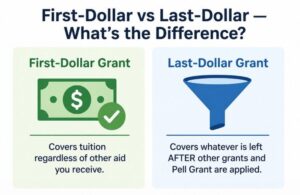
First-Dollar Grants
These cover your tuition regardless of any other financial aid you already have. Even if you qualify for a Pell Grant, the first-dollar program pays on top of it. These are rarer — but more valuable.
Last-Dollar Grants
These cover whatever tuition is left after all your other aid — Pell Grants, state grants, scholarships — has been applied. So if your Pell Grant already covers your full tuition, you won’t get additional money. But if there’s a gap, the program closes it.
Most state programs are last-dollar. That’s still genuinely useful — especially for students who don’t fully qualify for federal aid or whose Pell Grant doesn’t stretch far enough.
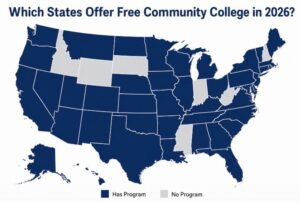
The 35 States Offering Free Community College in 2026
Here is the complete and updated list. We’ve organized it alphabetically so you can jump straight to your state.
Arkansas
Program: Arkansas Future Grant (ArFuture)
Who qualifies: Arkansas residents pursuing an associate degree or certificate in STEM, healthcare, manufacturing, or other high-demand fields at public institutions
What’s covered: Full tuition and fees
Type: Last-dollar
Note: Must enroll full or part-time and maintain GPA requirements
California
Program: California College Promise Grant (CCPG)
Who qualifies: California residents with demonstrated financial need enrolled in an eligible major at one of 53 participating community colleges
What’s covered: Enrollment fees for one full year
Type: Last-dollar
Note: Books and housing not covered. Apply through CCCApply. California also offers a newer initiative that provides stipends beyond the tuition waiver for some students.
Colorado
Program: Colorado Promise
Who qualifies: In-state students with family income of $90,000 or less, enrolling within two years of high school graduation
What’s covered: Tuition and fees for the first two years, at community colleges, public four-year schools, and technical colleges
Type: Last-dollar (up to 65 credit hours)
Note: Complete FAFSA or CASFA to apply
Connecticut
Program: CT State PACT (Pledge to Advance Connecticut)
Who qualifies: Connecticut residents who are first-time college students — no income limit
What’s covered: Tuition at any of 12 CT State community colleges
Type: Last-dollar
Note: Open to full-time and part-time students. One of the few programs with no income cap.
Delaware
Program: SEED Scholarship (Student Excellence Equals Degree)
Who qualifies: Delaware high school graduates and GED holders; students 25+ must show five years of state residency
What’s covered: Tuition at Delaware Technical Community College or the University of Delaware’s Associate of Arts program
Type: Last-dollar
Note: Apply by April 1. Books and fees not covered. Students can go part-time after first semester.
Florida
Program: Florida Bright Futures Scholarship
Who qualifies: Florida residents who graduate from a Florida high school and meet GPA and community service requirements
What’s covered: 75% to 100% of tuition and fees depending on the award tier
Type: Merit-based
Note: Florida doesn’t have a universal free program, but Bright Futures plus a Pell Grant often covers full community college costs for eligible students.
Georgia
Program: HOPE Career Grant and Zell Miller Grant
Who qualifies: Georgia residents pursuing high-demand fields like healthcare, IT, or manufacturing at technical colleges
What’s covered: Full tuition in qualifying programs
Type: Merit and need-based
Note: Georgia also offers the HOPE Grant which covers a portion of tuition based on GPA
Hawaii
Program: Hawaii Promise Program
Who qualifies: Hawaii residents demonstrating financial need, enrolled in at least six credits at a University of Hawaii community college
What’s covered: Tuition, fees, textbooks, and transportation
Type: Last-dollar
Note: One of the more comprehensive programs — covers transportation too, which is rare
Indiana
Program: 21st Century Scholarship and Workforce Ready Grant
Who qualifies: 21st Century is for students who enrolled in 8th grade and meet income/GPA requirements; Workforce Ready covers adults in specific in-demand fields
What’s covered: Full tuition at public colleges, partial at private
Type: Both last-dollar
Note: The 21st Century Scholarship requires enrollment by end of 8th grade — parents of younger students should sign up now
Iowa
Program: Future Ready Iowa Last-Dollar Scholarship
Who qualifies: Iowa residents pursuing a postsecondary certificate, diploma, or associate degree
What’s covered: Gap between financial aid and community college tuition
Type: Last-dollar
Note: Must be enrolled in an in-demand career program
Kansas
Program: Kansas Promise Act Scholarship
Who qualifies: Kansas residents at community or technical colleges in fields like IT, healthcare, early childhood education, and manufacturing
What’s covered: Tuition gap
Type: Last-dollar
Note: Must agree to live and work in Kansas for two years after graduation
Kentucky
Program: Work Ready Kentucky Scholarship
Who qualifies: Kentucky adults 18+ in qualifying workforce programs
What’s covered: Tuition and fees in specific high-demand programs
Type: Last-dollar
Note: Requires FAFSA completion and enrollment in approved program
Louisiana
Program: M.J. Foster Promise Program
Who qualifies: Louisiana residents who don’t have a prior degree and are pursuing a workforce-aligned two-year degree
What’s covered: Tuition, fees, and mandatory books and supplies
Type: Last-dollar
Note: One of the few programs that covers books and supplies
Maryland
Program: Community College Promise Scholarship
Who qualifies: Maryland residents with demonstrated financial need
What’s covered: Up to $5,000 to fill the gap between financial aid and tuition costs
Type: Last-dollar
Note: Funds are limited — apply as early as possible each year
Massachusetts ⭐ Best Program in 2026
Program: MassEducate (and MassReconnect for adults 25+)
Who qualifies: Any Massachusetts resident enrolled at one of the state’s 15 public community colleges — regardless of age or income
What’s covered: Full tuition and fees, plus up to $1,200 per year for books and supplies based on income
Type: Last-dollar
Note: This is one of the most generous programs in the country. No income limit. No age limit. If you live in Massachusetts and want to go to community college, you essentially go for free.
Michigan
Program: Michigan Reconnect
Who qualifies: Michigan residents 25 years or older who don’t have a college degree and have lived in the state for at least one year
What’s covered: Full tuition and fees at in-district community college
Type: Last-dollar
Note: Specifically designed for adult learners returning to education
Minnesota
Program: North Star Promise
Who qualifies: Minnesota residents with demonstrated financial need
What’s covered: Tuition at public colleges, including community colleges
Type: Last-dollar
Note: Complete FAFSA with Minnesota listed as a school
Mississippi
Program: Mississippi’s Promise Scholarship
Who qualifies: Mississippi residents pursuing high-demand workforce programs
What’s covered: Tuition and fees in qualifying programs
Type: Last-dollar
Missouri
Program: A+ Scholarship Program
Who qualifies: Missouri residents who graduated from a participating high school with a 2.5 GPA and completed 50 hours of unpaid tutoring/mentoring
What’s covered: Full tuition and fees at community colleges and vocational schools
Type: Last-dollar
Montana
Program: Montana Promise Grant
Who qualifies: Montana residents with financial need enrolled at Montana community colleges
What’s covered: Tuition gap after Pell Grant
Type: Last-dollar
Nevada
Program: Nevada Promise Scholarship
Who qualifies: Nevada high school graduates within two years of graduation
What’s covered: Tuition and fees at Nevada community colleges
Type: Last-dollar
Note: Requires mentoring participation during enrollment
New Jersey
Program: New Jersey Community College Opportunity Grant
Who qualifies: New Jersey residents with low to moderate income enrolled at a county college
What’s covered: Tuition and fees
Type: Last-dollar
New Mexico
Program: New Mexico Opportunity Scholarship
Who qualifies: New Mexico residents with household income below $30,000
What’s covered: Full tuition and fees at public two- and four-year institutions
Type: First-dollar
Note: One of the rare first-dollar programs in the country
New York ⭐ Big Update for 2026
Program: Excelsior Scholarship + FY 2026 Budget Expansion
Who qualifies: New York residents with household income up to $80,000 (Excelsior) or up to $125,000 (other programs)
What’s covered: The FY 2026 state budget now covers tuition, fees, AND books for eligible students at any SUNY or CUNY school — including all New York City community colleges
Type: Last-dollar
Note: This is a major 2026 expansion. Books are now included, which was not the case before. New York students should check updated eligibility with their financial aid office.
North Carolina
Program: NC Next Scholarship
Who qualifies: North Carolina residents at state community colleges
What’s covered: Tuition and fees
Type: Last-dollar
Ohio
Program: Ohio College Opportunity Grant
Who qualifies: Ohio residents with demonstrated financial need
What’s covered: Tuition assistance at Ohio community colleges
Type: Need-based
Oklahoma
Program: Oklahoma’s Promise
Who qualifies: Oklahoma students who enroll in 8th or 9th grade, maintain a 2.5 GPA, and have family income under $55,000
What’s covered: Full tuition at Oklahoma public colleges and universities
Type: First-dollar
Note: Parents need to enroll their children early — eligibility requires 8th or 9th grade sign-up
Oregon
Program: Oregon Promise
Who qualifies: Oregon high school graduates or GED recipients enrolling within six months
What’s covered: Tuition at Oregon community colleges
Type: Last-dollar
Note: Must maintain 2.0 GPA and 6+ credits per term
Rhode Island
Program: Rhode Island Promise
Who qualifies: Rhode Island high school graduates enrolling the semester after graduation at the Community College of Rhode Island (CCRI)
What’s covered: Two years of free tuition
Type: Last-dollar
Note: Must enroll right after high school — returning adults should check MassEducate if near the Massachusetts border
Tennessee ⭐ Where It All Started
Program: Tennessee Promise
Who qualifies: Tennessee high school graduates — all of them, regardless of income
What’s covered: Full tuition and fees at any Tennessee community college or technical school
Type: Last-dollar
Note: Tennessee was the first state in the country to launch a free community college program statewide back in 2014. It has since helped hundreds of thousands of students graduate debt-free.
Texas
Program: Various county and district-level programs (no statewide universal program)
Who qualifies: Varies by county
What’s covered: Varies by program
Note: Texas doesn’t have one unified statewide program, but many community college districts have their own Promise Programs. Check with your local community college directly.
Virginia
Program: Virginia’s Get Skilled, Get a Job, Give Back (G3)
Who qualifies: Low- and middle-income Virginia residents pursuing workforce credentials in high-demand fields
What’s covered: Tuition, fees, books, and some living expenses
Type: Last-dollar
Note: One of the more comprehensive programs — covers living expenses for qualifying students
Washington
Program: College Bound Scholarship
Who qualifies: Washington students who enrolled in 6th, 7th, 8th, or 9th grade while on the free/reduced lunch program or in foster care
What’s covered: Tuition, fees, and a small living allowance at Washington public colleges
Type: First-dollar
Note: Students and parents need to sign the pledge early. Once enrolled and eligible, the funding follows them through college.
West Virginia
Program: West Virginia Invests Grant
Who qualifies: West Virginia residents pursuing in-demand workforce programs at community and technical colleges
What’s covered: Tuition and fees
Type: Last-dollar
Wisconsin
Program: Wisconsin Technical Excellence Scholarship
Who qualifies: Wisconsin residents with demonstrated financial need at technical colleges
What’s covered: Tuition gap
Type: Last-dollar
Wyoming
Program: Wyoming Hathaway Scholarship
Who qualifies: Wyoming high school graduates based on GPA and ACT/SAT scores
What’s covered: Tuition at Wyoming community colleges
Type: Merit-based
Important 2026 Update — Maine Ended Its Program
If you’ve seen older articles listing Maine as a state with free community college — that’s no longer accurate.
Maine ran a Free College Scholarship program for three years. But in June 2025, the governor signed a new state budget that effectively ended the program with the class of 2025.
Current and future Maine students should focus on federal Pell Grants and check with individual Maine community colleges for institutional aid options.
What If Your State Isn’t on This List?
Don’t give up just yet. Even if your state doesn’t have a formal Promise Program, you have options.
The federal Pell Grant is the most important one. For the 2025–2026 academic year, the maximum Pell Grant award is $7,395. The average annual in-district community college tuition is $3,780. That means for millions of qualifying students, the Pell Grant already covers the full cost of community college — even without a state program.
You can also check with your specific community college. Many have their own institutional scholarships and emergency grant funds that never get advertised widely. A five-minute conversation with a financial aid advisor can sometimes unlock thousands of dollars that weren’t showing up on your award letter.
How to Apply — Step by Step
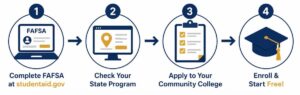
The process is simpler than most people expect. Here’s how it works:
Step 1 — Complete the FAFSA
This is non-negotiable. Almost every state program requires FAFSA completion. Go to studentaid.gov and complete your FAFSA as early as possible. Some state programs have limited funding and award it on a first-come, first-served basis. Filing early protects your spot.
Step 2 — Look Up Your State’s Program
Search “[your state] free community college program 2026” or go directly to your state’s higher education website. Confirm the eligibility requirements and check the application deadline — some programs have deadlines in April or May for the fall semester.
Step 3 — Apply to Your Community College
Apply for admission at an eligible community college in your state. Most applications are free or charge a small fee. The financial aid office will apply your state grant automatically once your FAFSA is processed — in most cases, you don’t need to submit a separate application for the Promise Program itself.
Step 4 — Enroll and Stay Eligible
Most programs require you to maintain a minimum GPA (usually 2.0 or 2.5) and stay enrolled in at least 6 credits per semester. Some programs have additional requirements like attending workshops, participating in mentoring, or committing to work in the state after graduation. Read the terms before you enroll.
What These Programs Do and Don’t Cover
| Item | Typically Covered? |
|---|---|
| Tuition | ✅ Yes — in most programs |
| Mandatory fees | ✅ Yes — in many programs |
| Textbooks | ⚠️ Only in some (Louisiana, Hawaii, Virginia, New York 2026) |
| Housing / Room & Board | ❌ Almost never covered |
| Transportation | ⚠️ Only in some (Hawaii, Virginia G3) |
| Technology / Laptop | ❌ Not covered |
| Health insurance | ❌ Not covered |
Plan your budget around these gaps before you enroll. Many community colleges have food pantries, laptop lending programs, and emergency fund assistance for students who are struggling with non-tuition expenses.
Frequently Asked Questions
Is community college free everywhere in the US in 2026?
No. There is no federal free community college program currently in effect. However, 35 states now operate their own Promise Programs that make community college tuition free or significantly reduced for qualifying residents.
Do I have to be a recent high school graduate to qualify?
Not always. Some programs — like Massachusetts MassEducate, Michigan Reconnect, and Virginia G3 — are specifically designed for adult learners returning to school. Others are limited to students enrolling within one or two years of high school graduation. Check the specific rules for your state.
What GPA do I need to keep my free tuition?
Most programs require a minimum 2.0 GPA, though some require 2.5. You also typically need to complete more than half of the credits you attempt each semester. If you drop below the threshold, you may lose eligibility — though some programs allow a one-time reinstatement if you appeal.
Can I transfer to a four-year university after community college?
Yes — and this is actually one of the smartest financial moves a student can make. Completing your first two years at a free community college and then transferring to a four-year university can save tens of thousands of dollars. Many states have transfer agreements between community colleges and public universities.
Does free community college affect my Pell Grant?
Because most programs are “last-dollar,” your Pell Grant is applied first. The state program then covers whatever tuition is left. In some cases, if your Pell Grant already covers your full tuition, you may not receive additional state funding. But you won’t lose your Pell Grant by participating in a state program.
What happens if I move to another state — do I lose my free tuition?
Yes. All of these programs require you to be a current resident of the state. If you move, you lose eligibility. Some programs also require you to live and work in the state for a certain period after graduation.
Are online courses covered by these programs?
Usually yes, as long as you are enrolled at an eligible in-state community college and the online course counts toward your degree program. Check with your specific college’s financial aid office to confirm.
Bottom Line — Don’t Leave This Money on the Table
In 2026, not knowing about free community college programs is genuinely expensive.
Thirty-five states are actively offering to pay for your education. The programs exist, the funding is real, and the application process is simpler than most people think. The only thing standing between most students and free tuition is knowing where to look and filing the FAFSA on time.
If your state is on this list, start with your FAFSA at studentaid.gov. Then contact the financial aid office at your local community college and ask specifically about state Promise Programs.
If your state isn’t on the list, check the Pell Grant — you might find that federal aid already covers your full tuition without any additional program needed.
Either way, community college in 2026 is more accessible than it has ever been. Use it.
Some Official Resources:
- FAFSA Application: studentaid.gov
- College Promise Campaign (full program tracker): collegepromise.org
- Federal Pell Grant information: studentaid.gov/pell